Comparison of manual hydraulic forklifts with other handling equipment
In the daily operation of the warehouse, handling equipment is a key tool to improve work efficiency. In addition to the common manual hydraulic forklifts, electric forklifts and pushers are also "regulars" in warehouses. These devices have their own merits in terms of performance, applicable scenarios, etc., and the following will compare them in detail so that you can choose the most suitable equipment according to the actual working environment.
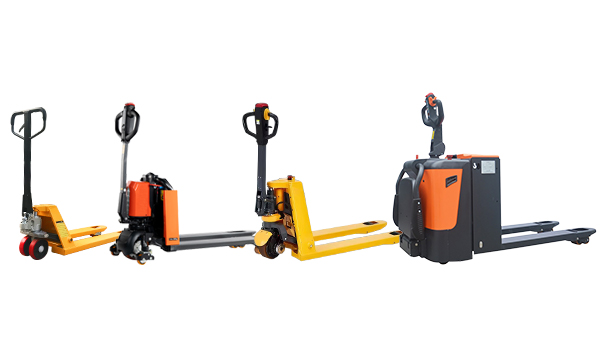
Comparison of manual hydraulic forklift and electric forklift
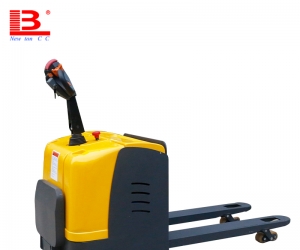
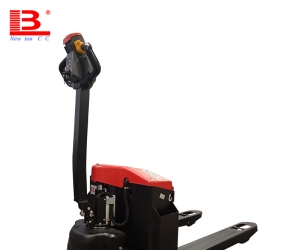
Electric forklifts excel in large-scale, high-intensity work scenarios, especially when heavy goods need to be handled or when continuous operations are required for long periods of time. Its strong power output ensures high work efficiency, so it is often seen in large warehouses as well as in heavy lifting work.
• Advantages: It has the ability to handle heavier cargo, and the operation speed is fast, which can adapt to long-term work needs.
• Disadvantages: The purchase cost is relatively high, the subsequent maintenance cost is not low, and due to the limitation of battery life, it may affect the operation progress without timely charging.
Manual hydraulic forklifts are more suitable for use in low-level, short-distance light load handling scenarios, especially in places where space is tight, it is flexible to operate and has lower costs. Although it is not as efficient as electric forklifts, its lightness and low cost make it very practical in many working environments.
• Advantages: Low cost, simple and easy to understand, ideal for small-scale cargo handling work.
• Disadvantages: limited load capacity, low operating efficiency, can only be used to handle lighter goods.
Comparison of manual hydraulic forklift and push truck
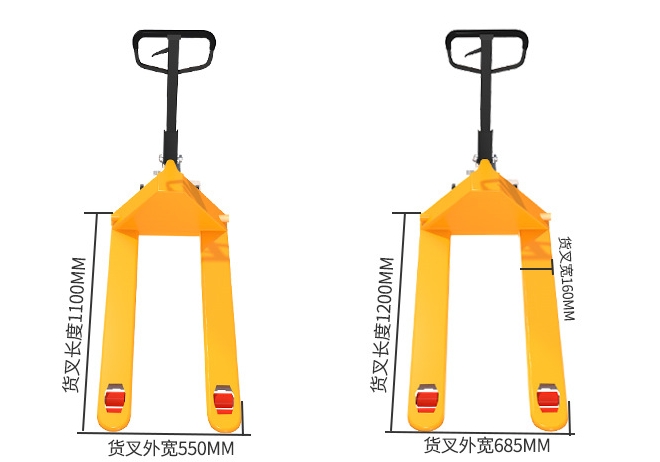
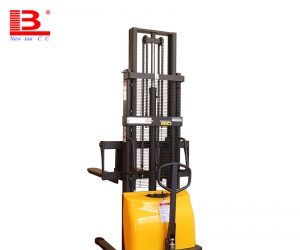
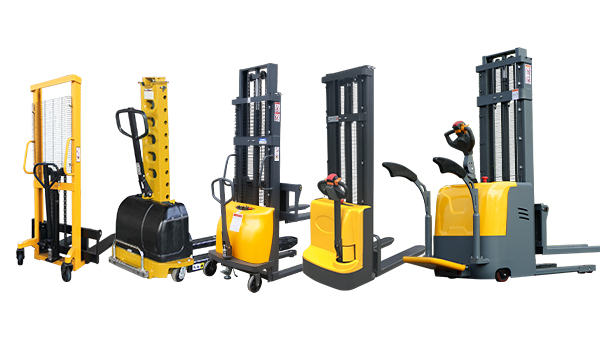
The main function of the pusher is to lift the goods to a higher position, so it is very suitable for high storage or stacking of goods. Generally speaking, it has a strong lifting capacity, but in terms of the flexibility of cargo handling, it is slightly inferior to manual hydraulic forklifts, which is a bit bulky.
• Advantages: It is suitable for loading and retrieving goods on high shelves, and the handling efficiency is high.
• Disadvantages: The range of applicable scenarios is relatively narrow, and the flexibility of operation is not as good as that of manual hydraulic forklifts.
Manual hydraulic forklifts are more focused on short-distance cargo transportation on the ground and are very flexible to operate in tight spaces. Its main advantages are easy operation and low maintenance cost, but it does not have the function of high-level access to goods and cannot be used in scenarios that require high-level operations.
Performance comparison of various types of equipment
• Load capacity: Electric forklifts have the strongest load capacity, followed by push-up trucks, and manual hydraulic forklifts have relatively weak load capacity, i.e., electric forklifts > push-up trucks > manual hydraulic forklifts.
• Operational flexibility: Manual hydraulic forklifts perform best in terms of operational flexibility, followed by push-up trucks, and electric forklifts are slightly less flexible, i.e., manual hydraulic forklifts > push-up trucks > electric forklifts.
• Maintenance cost: Manual hydraulic forklifts have the lowest maintenance costs, push-up trucks have moderate maintenance costs, and electric forklifts have the highest maintenance costs, i.e., manual hydraulic forklifts < push-up trucks < electric forklifts.
summary
On the whole, manual hydraulic forklifts are suitable for light loads and short-distance cargo handling, especially in working environments with limited space. electric forklifts are suitable for large-scale, heavy handling and high-efficiency operation scenarios; The advantages of pushing up trucks are mainly reflected in the loading and retrieving operations of high racks. When choosing, the most suitable equipment should be selected according to the actual operation needs and environmental characteristics to improve the operational efficiency of the warehouse.
-
 Reliability Of Newnewton Warehouse Forklifts For Heavy-Duty ShiftsWarehouse forklift reliability relies on industrial parts, reinforced frames and factory durability tests. Proper operation and maintenance reduce unexpected downtime.
Do you like ?0
Read more -
 Forklift Configuration Strategy For Dense Warehousing, Warehouse ForkliftDense warehousing needs matched forklifts besides racks. Reach and trilateral stackers fit different layouts, coordinate aisle, load curve and floor for smooth handling.
Do you like ?0
Read more -
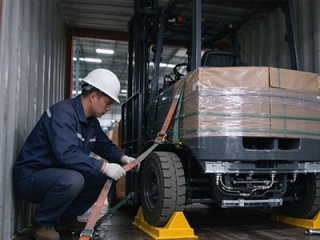 Full Container Supply For Export Forklifts, Forklift ManufacturerBulk forklift orders for overseas can ship by FCL or LCL. Newnewton FCL offers stable freight, safer packing and mixed models for large purchases.
Do you like ?0
Read more -
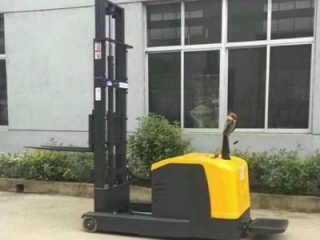 Stand-on Reach Stacker For Narrow Aisle Stacking, Mast Reach StructureStand-on reach stackers feature sliding masts that stay outside racks. They boost storage density in narrow aisles and require flat floors and standard pallets.
Do you like ?0
Read more -
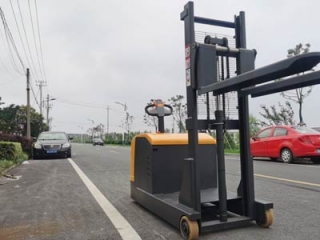 Stand-on Counterbalance Stacker For Various Pallets, Why No Leg RestrictionCounterbalance stackers have no front outriggers, using rear counterweight to avoid pallet interference. They fit various odd pallets yet need wider warehouse aisles.
Do you like ?0
Read more -
 Custom Walk-Behind Counterbalance Stacker | Non-Standard ModificationsStandard walk-behind counterbalance stackers struggle with non-standard pallets and tight aisles. Customize load, lift, forks and structure, share working conditions for safe design.
Do you like ?0
Read more