What Are the Differences Between Cross-leg Stacker and Legless Stacker?
Many buyers can hardly tell the differences between cross-leg stackers and legless stackers. To help you get a clear understanding and choose the right warehouse handling equipment accurately, especially for those planning to purchase a walk-behind cross-leg fully electric stacker, this guide will explain their key features in detail.
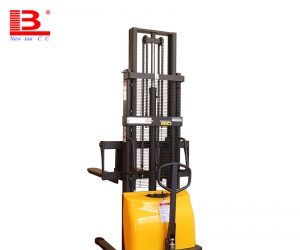
Cross-leg design: Equipped with supporting cross legs on both left and right sides under the frame, the forks are placed in the middle of the cross legs, delivering excellent overall stability.
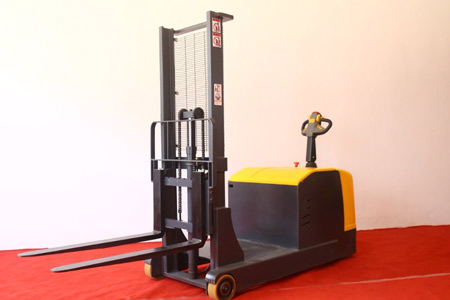
Legless design: No supporting legs, only pallet forks; balance is realized by the counterweight at the rear of the truck.
The two structural designs are professionally developed according to actual working conditions, aisle width, site terrain and other practical factors, aiming to solve different stacking and material handling challenges.
Different applicable pallets: The cross-leg stacker fits standard double-sided and four-way pallets with strong versatility; while the legless stacker is only compatible with single-sided pallets with hollow out bottom chassis.
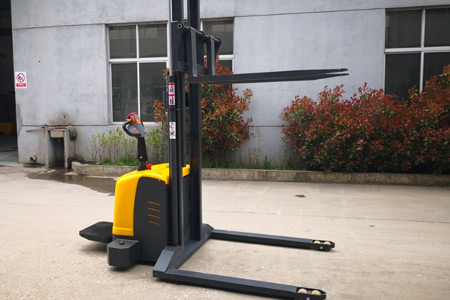
Load stability: The cross-leg stacker features a large supporting area, stable lifting performance and low risk of tipping over. The legless stacker relies on rear counterweight, so it tends to shake when lifting goods to a high height with poorer stability.
Floor requirements: The cross-leg stacker works well on ordinary cement floors and can adapt to slightly uneven ground. The legless stacker has higher requirements, needing flat and hard ground, and is easy to tilt or slip on uneven surfaces.
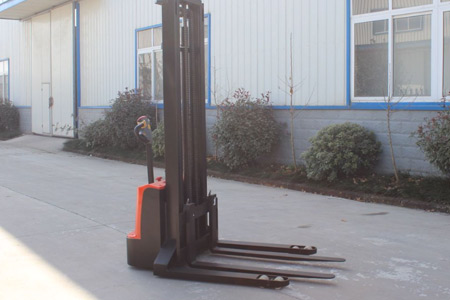
Aisle width: Both are suitable for medium and small warehouse aisles, but the legless stacker can pass through narrower compact aisles compared with the cross-leg stacker.
Cost performance & price: The legless stacker has higher structural and counterweight costs, so its price is higher than that of the cross-leg stacker.
It is obvious to see the differences between cross-leg stacker and legless stacker. You can select the ideal forklift based on your actual working scenarios, improving work efficiency, lowering operating costs and gaining better cost performance for your warehouse business.
-
 Reliability Of Newnewton Warehouse Forklifts For Heavy-Duty ShiftsWarehouse forklift reliability relies on industrial parts, reinforced frames and factory durability tests. Proper operation and maintenance reduce unexpected downtime.
Do you like ?0
Read more -
 Forklift Configuration Strategy For Dense Warehousing, Warehouse ForkliftDense warehousing needs matched forklifts besides racks. Reach and trilateral stackers fit different layouts, coordinate aisle, load curve and floor for smooth handling.
Do you like ?0
Read more -
 Full Container Supply For Export Forklifts, Forklift ManufacturerBulk forklift orders for overseas can ship by FCL or LCL. Newnewton FCL offers stable freight, safer packing and mixed models for large purchases.
Do you like ?0
Read more -
 Stand-on Reach Stacker For Narrow Aisle Stacking, Mast Reach StructureStand-on reach stackers feature sliding masts that stay outside racks. They boost storage density in narrow aisles and require flat floors and standard pallets.
Do you like ?0
Read more -
 Stand-on Counterbalance Stacker For Various Pallets, Why No Leg RestrictionCounterbalance stackers have no front outriggers, using rear counterweight to avoid pallet interference. They fit various odd pallets yet need wider warehouse aisles.
Do you like ?0
Read more -
 Custom Walk-Behind Counterbalance Stacker | Non-Standard ModificationsStandard walk-behind counterbalance stackers struggle with non-standard pallets and tight aisles. Customize load, lift, forks and structure, share working conditions for safe design.
Do you like ?0
Read more