2026 Guide to Manual Hydraulic Pallet Stacker Maintenance | Latest Annual
Manual pallet stackers are essential equipment for many small and medium-sized factories. To keep your equipment efficient, durable and cost-effective, proper manual hydraulic pallet stacker maintenance is crucial. In this article, we summarize the latest tips and procedures to help you maintain your stacker properly.
As factory and warehouse safety equipment, manual pallet stackers require mandatory annual internal inspections, which we recommend completing together with routine maintenance.
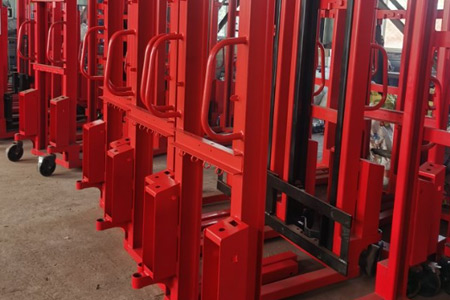
Self-Inspection Items (2026 Standards)
Structure and WeldsFrame, mast and forks must be free of cracks and obvious deformation.Welds should show no signs of cracking or rust perforation.Fork tip wear must not exceed 15% of the original thickness; replace forks if the limit is exceeded.Pins, chains and connecting parts must be secure and free of excessive wear.
Hydraulic System (Core Component)Cylinders, hoses and connectors must be free of oil leakage.Lifting operation should be smooth, without jamming or automatic lowering. Under rated load, the stacker must not sink more than 5mm within 10 minutes.Hydraulic oil must be clean, at proper level and free of emulsification. Oil change is recommended annually.The lowering control handle must be responsive and not stuck.
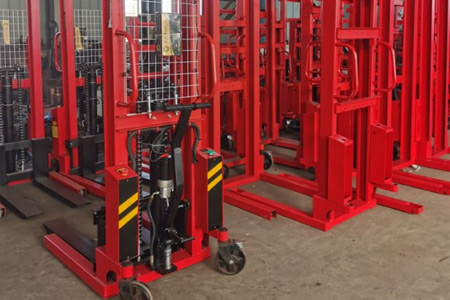
Mobility and SteeringWheels and PU wheels must be intact, without cracks or missing pieces, and rotate smoothly.Bearings should run smoothly, without noise or blockage, and be properly lubricated.Tread depth must be at least 3.2mm.
Safety Labels and NameplatesRated load, model and serial number must be permanently legible.No unauthorized modifications or signs of overloading are allowed.
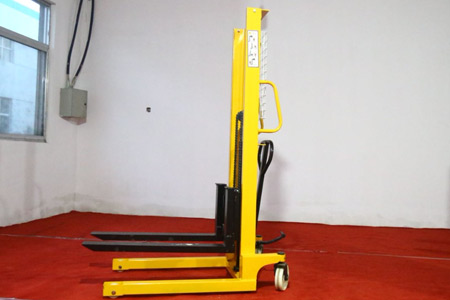
Required Documentation
Annual Inspection & Maintenance RecordsAnnual self-inspection report with signature and official seal.Daily maintenance logs including date, items and replaced parts.Repair records listing faults, causes and solutions.Original certification and operation manual.
Annual inspection requirements for manual pallet stackers may seem detailed, but they are a necessary part of safe operation. You can perform inspections step by step following the standards above.
-
 Reliability Of Newnewton Warehouse Forklifts For Heavy-Duty ShiftsWarehouse forklift reliability relies on industrial parts, reinforced frames and factory durability tests. Proper operation and maintenance reduce unexpected downtime.
Do you like ?0
Read more -
 Forklift Configuration Strategy For Dense Warehousing, Warehouse ForkliftDense warehousing needs matched forklifts besides racks. Reach and trilateral stackers fit different layouts, coordinate aisle, load curve and floor for smooth handling.
Do you like ?0
Read more -
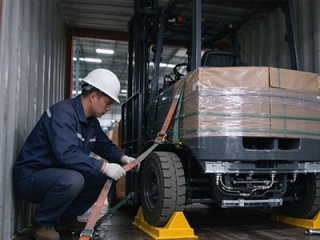 Full Container Supply For Export Forklifts, Forklift ManufacturerBulk forklift orders for overseas can ship by FCL or LCL. Newnewton FCL offers stable freight, safer packing and mixed models for large purchases.
Do you like ?0
Read more -
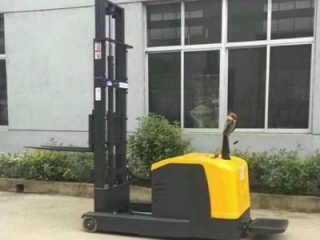 Stand-on Reach Stacker For Narrow Aisle Stacking, Mast Reach StructureStand-on reach stackers feature sliding masts that stay outside racks. They boost storage density in narrow aisles and require flat floors and standard pallets.
Do you like ?0
Read more -
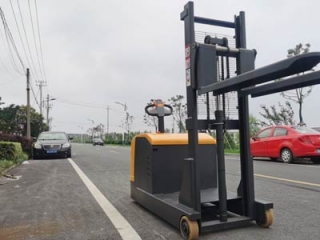 Stand-on Counterbalance Stacker For Various Pallets, Why No Leg RestrictionCounterbalance stackers have no front outriggers, using rear counterweight to avoid pallet interference. They fit various odd pallets yet need wider warehouse aisles.
Do you like ?0
Read more -
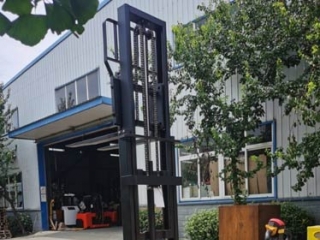 Custom Walk-Behind Counterbalance Stacker | Non-Standard ModificationsStandard walk-behind counterbalance stackers struggle with non-standard pallets and tight aisles. Customize load, lift, forks and structure, share working conditions for safe design.
Do you like ?0
Read more