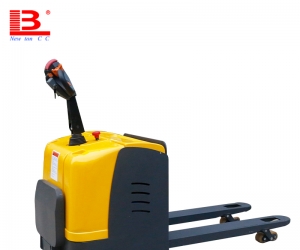
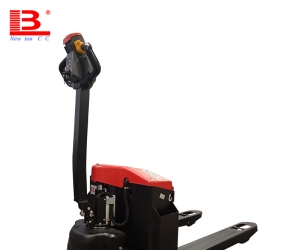
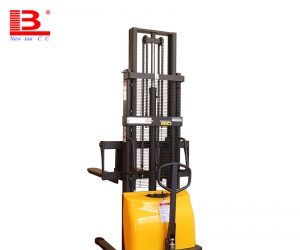
Many warehouses focus on the stand-on counterbalance stacker when upgrading equipment,but do not clearly understand its structure, legless design and other details, so they don’t know how to choose the right stand-on counterbalance stacker.In this article, we explain everything clearly to help you choose correctly and use it safely.
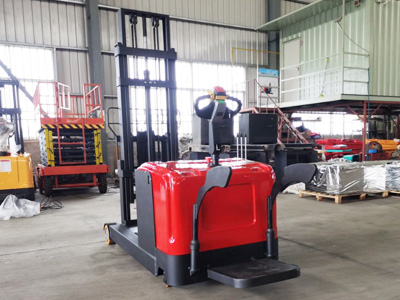
First, let’s look at the structure of stand-on counterbalance stacker.Its biggest feature is no front outriggers. It achieves balance using the counterweight at the rear of the machine,equipped with a stand-on operating platform, electric drive and electric lifting system.The overall structure is compact, stable in center of gravity and flexible in control.The mast lifts vertically, and the forks require no support points.It can lift cargo smoothly and turn freely in narrow spaces – the core advantage over standard leg-type stackers.
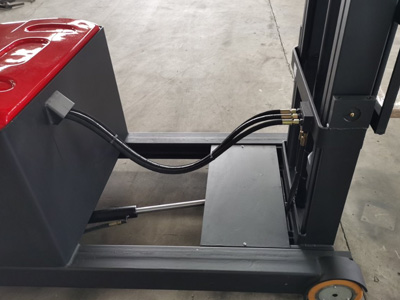
Next, let’s cover application scenarios of legless stackers.With no front outriggers, it is especially suitable for truck loading and unloading without a platform.It also performs well in small warehouses, narrow-aisle workshops, cold rooms, supermarket backyards and other space-limited areas.It has low requirements for ground conditions, compatible with various pallets and sites.Whether for full-pallet transfer or high-level stacking, it handles tasks easily with strong practicability.
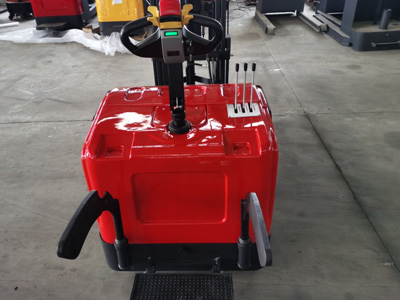
Finally, we focus on how to choose a stand-on counterbalance stacker.
Check load capacity and lifting height to match your daily cargo weight and rack height.
Pay attention to battery life and motor performance to ensure stable long-time operation.
Inspect operation comfort and safety features, such as emergency reverse, anti-slip pedals, and overload protection.
Choose factory-direct brands with complete after-sales service for better long-term reliability.
-
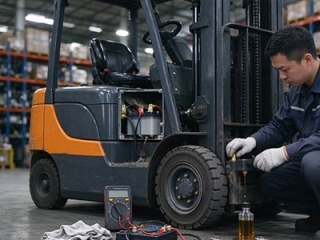 Reliability Of Newnewton Warehouse Forklifts For Heavy-Duty ShiftsWarehouse forklift reliability relies on industrial parts, reinforced frames and factory durability tests. Proper operation and maintenance reduce unexpected downtime.
Do you like ?0
Read more -
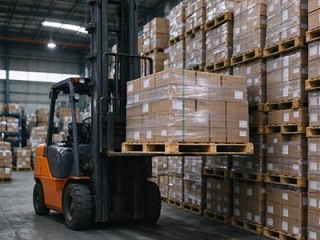 Forklift Configuration Strategy For Dense Warehousing, Warehouse ForkliftDense warehousing needs matched forklifts besides racks. Reach and trilateral stackers fit different layouts, coordinate aisle, load curve and floor for smooth handling.
Do you like ?0
Read more -
 Full Container Supply For Export Forklifts, Forklift ManufacturerBulk forklift orders for overseas can ship by FCL or LCL. Newnewton FCL offers stable freight, safer packing and mixed models for large purchases.
Do you like ?0
Read more -
 Stand-on Reach Stacker For Narrow Aisle Stacking, Mast Reach StructureStand-on reach stackers feature sliding masts that stay outside racks. They boost storage density in narrow aisles and require flat floors and standard pallets.
Do you like ?0
Read more -
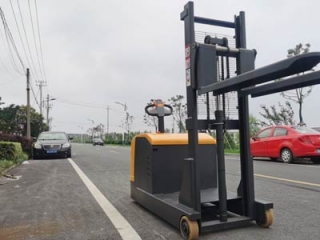 Stand-on Counterbalance Stacker For Various Pallets, Why No Leg RestrictionCounterbalance stackers have no front outriggers, using rear counterweight to avoid pallet interference. They fit various odd pallets yet need wider warehouse aisles.
Do you like ?0
Read more -
 Custom Walk-Behind Counterbalance Stacker | Non-Standard ModificationsStandard walk-behind counterbalance stackers struggle with non-standard pallets and tight aisles. Customize load, lift, forks and structure, share working conditions for safe design.
Do you like ?0
Read more