Fault Repair For Walk-behind Counterbalance Stacker | Weak Lifting Fix Guide
Weak lifting and failure to reach full height on your Walk-behind Counterbalance Stacker halt warehouse workflows and trigger expensive repair bills. Before contacting professional service technicians, identify the root causes first. This complete Fault Repair For Walk-behind Counterbalance Stacker guide breaks down four core failure sources: hydraulic system wear, insufficient battery power, degraded lift motor output, and pressure relief valve pressure loss.
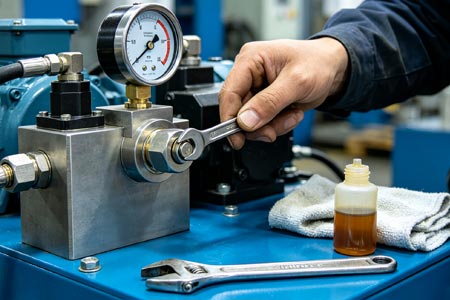
1. Hydraulic System Wear & Pressure Loss (Most Common Failure)
Symptom 1: Lifts smoothly with empty forks, slow & half-height under load
Fault reason: Insufficient hydraulic pressure caused by low oil, damaged pump or deteriorated fluid Repair steps:
Fully lower forks to release pressure, check oil tank scale; top up with matched No.32 anti-wear hydraulic oil if below minimum mark.
Drain all fluid completely if oil turns black, contains impurities or emulsifies milky white; clean tank filter and refill brand-new hydraulic oil.
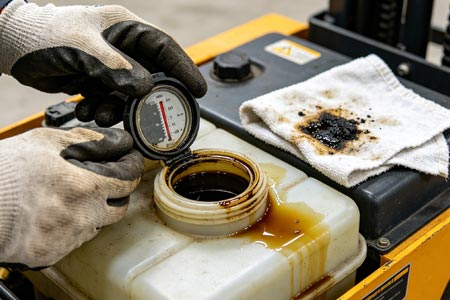
Never mix different hydraulic oil grades; abrasive particles wear internal pump gears and permanently cut lifting pressure.
Symptom 2: Normal empty lifting, weak loaded lifting & limited max height
Fault reason: Relief valve pressure leakage, unable to hit rated working pressure Repair steps:
Cut power and release hydraulic pressure, locate adjustable relief valve on hydraulic power unit side.
Tighten adjusting screw clockwise by 1/4 turn each time, test full-load lifting repeatedly after each adjustment.
Replace full relief valve assembly if lifting remains weak after fine-tuning, indicating worn valve spool.
Symptom 3: Loud noise & obvious shaking during lifting, continuously slower lifting speed
Fault reason: Worn hydraulic pump leading to inadequate oil supply pressure Solution: Disassemble pump to inspect gear wear; replace seal kits for minor abrasion, swap full hydraulic power unit for severely worn gears.
Symptom 4: Humming noise during lifting, slow fork sinking & weak lifting power
Fault reason: Internal cylinder seal leakage or external hose seepage Repair steps:
Check cylinder outer wall for oil stains; tighten loose bolts first for leaking hose joints.
Replace full oil seal & dust wiper kit if forks sink automatically after lifting and cannot hold pressure.
Swap damaged high-pressure oil hoses and add sealing washers on all connections.
2. Insufficient Battery Power Supply
General symptom: Dim dashboard lights while lifting, sharp drop of lifting speed, temporary recovery after full charging
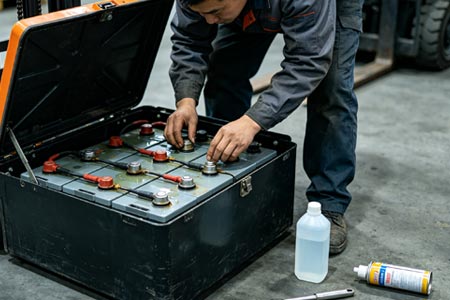
Lead-acid battery troubleshooting
Open battery cover, inspect electrolyte level; top up only distilled water if liquid sits below plates.
Wipe white corrosive powder on terminals with hot water, fully dry and coat anti-rust vaseline, retighten loose terminals.
Replace full battery pack if single cell voltage drops severely, which means aged plates.
Avoid fast charging under high temperature; cool battery fully after charging before operation to slow aging.
Lithium battery troubleshooting
Inspect battery plugs and main harness for overheating & loose connection, re-clamp all terminals tightly.
Replace whole battery pack if single cell capacity decays; never store the stacker with fully drained power long-term.
Clear dust blocking battery cooling fan to restore heat dissipation.
3. Lift Motor & Circuit Malfunctions
Worn motor carbon brushes reduce power output
Repair: Disassemble motor housing, replace worn carbon brushes, clear internal carbon powder and polish commutator. Complete carbon brush wear will cause total loss of lifting function.
Burned contactor contacts create intermittent power supply
Repair: Open electric control box; polish lightly blackened contacts or replace lift contactor assembly for severe adhesion & burning.
Poor contact of lift micro switch on control handle
Repair: Disassemble handle shell to wipe oxidized switch contacts; swap micro switch if it fails to trigger lifting commands.
4. Jammed Mast Chains Increase Lifting Load (False Weak Lifting)
Dry chains or wrapped debris add extra resistance to motor and hydraulic system, presenting as weak lifting performance Repair steps:
Clear plastic strapping, carton scraps tangled around lifting chains.
Apply uniform chain grease, adjust tension of two chains to keep consistent sag.
Inject grease into mast slide rails to eliminate jamming resistance during vertical movement.
The Fault Repair For Walk-behind Counterbalance Stacker process is simple once you pinpoint the root failure. Independent on-site maintenance cuts costly downtime and repair fees, restoring your Walk-behind Counterbalance Stacker to normal operation quickly.
-
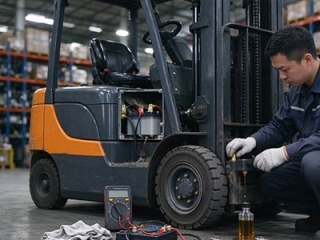 Reliability Of Newnewton Warehouse Forklifts For Heavy-Duty ShiftsWarehouse forklift reliability relies on industrial parts, reinforced frames and factory durability tests. Proper operation and maintenance reduce unexpected downtime.
Do you like ?0
Read more -
 Forklift Configuration Strategy For Dense Warehousing, Warehouse ForkliftDense warehousing needs matched forklifts besides racks. Reach and trilateral stackers fit different layouts, coordinate aisle, load curve and floor for smooth handling.
Do you like ?0
Read more -
 Full Container Supply For Export Forklifts, Forklift ManufacturerBulk forklift orders for overseas can ship by FCL or LCL. Newnewton FCL offers stable freight, safer packing and mixed models for large purchases.
Do you like ?0
Read more -
 Stand-on Reach Stacker For Narrow Aisle Stacking, Mast Reach StructureStand-on reach stackers feature sliding masts that stay outside racks. They boost storage density in narrow aisles and require flat floors and standard pallets.
Do you like ?0
Read more -
 Stand-on Counterbalance Stacker For Various Pallets, Why No Leg RestrictionCounterbalance stackers have no front outriggers, using rear counterweight to avoid pallet interference. They fit various odd pallets yet need wider warehouse aisles.
Do you like ?0
Read more -
 Custom Walk-Behind Counterbalance Stacker | Non-Standard ModificationsStandard walk-behind counterbalance stackers struggle with non-standard pallets and tight aisles. Customize load, lift, forks and structure, share working conditions for safe design.
Do you like ?0
Read more