
Stand-on Counterbalance Stacker: Standard Aisle Width for Warehouse Use
Many warehouse managers struggle with equipment selection due to unreasonable aisle space. To solve layout confusion, it is critical to figure out suitable aisle width for counterbalance stacker before procurement, avoiding pallet collision, equipment jamming and unnecessary budget waste.
The stand-on counterbalance stacker features flexible passing performance and adapts to different warehouse aisle conditions, with clear width standards for different operational scenarios.
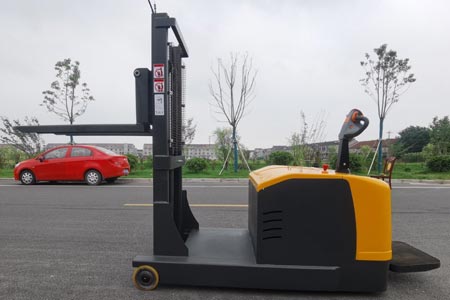
For extreme compact passage, the stacker can pass through 2.6–2.7m aisles with folded pedals and a compact body state. This mode is only suitable for short-distance straight driving and small-angle turning, not for long-term frequent operation.
For daily regular warehouse work, an aisle width of 2.8–3.0m is the most practical. It supports smooth 90-degree pallet picking and placing with sufficient safety margin, perfectly matching most medium and small warehouse handling scenarios.
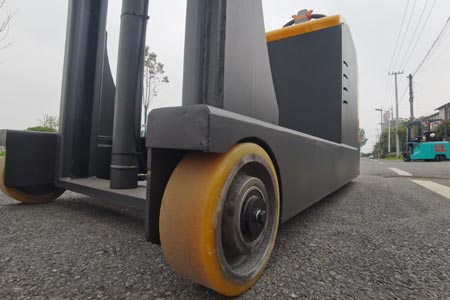
For high-standard safe operation, a 3.0–3.2m aisle is ideal. It allows full-load operation, unfolded pedals and simultaneous staff passage, ensuring broad vision, unobstructed movement and lower accident rates.
Custom ultra-narrow models achieve an extreme aisle width of about 2.0m, adopting an ultra-thin body and ultra-small turning radius. This customized type is limited to a load capacity of 1.5 tons or less for special narrow warehouse layouts.
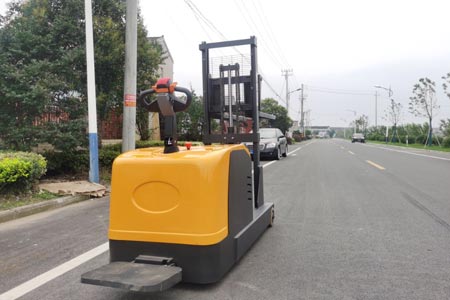
In actual selection, the turning radius should be matched with common pallet sizes, including mainstream domestic and international specifications. Always reserve a certain tolerance space according to the actual site environment.
With stable overall performance and strong scene adaptability, the stand-on counterbalance stacker is the preferred equipment for modern warehouse stacking. Contact us for professional parameter matching and customized solutions!
-
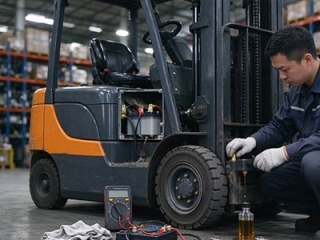 Reliability Of Newnewton Warehouse Forklifts For Heavy-Duty ShiftsWarehouse forklift reliability relies on industrial parts, reinforced frames and factory durability tests. Proper operation and maintenance reduce unexpected downtime.
Do you like ?0
Read more -
 Forklift Configuration Strategy For Dense Warehousing, Warehouse ForkliftDense warehousing needs matched forklifts besides racks. Reach and trilateral stackers fit different layouts, coordinate aisle, load curve and floor for smooth handling.
Do you like ?0
Read more -
 Full Container Supply For Export Forklifts, Forklift ManufacturerBulk forklift orders for overseas can ship by FCL or LCL. Newnewton FCL offers stable freight, safer packing and mixed models for large purchases.
Do you like ?0
Read more -
 Stand-on Reach Stacker For Narrow Aisle Stacking, Mast Reach StructureStand-on reach stackers feature sliding masts that stay outside racks. They boost storage density in narrow aisles and require flat floors and standard pallets.
Do you like ?0
Read more -
 Stand-on Counterbalance Stacker For Various Pallets, Why No Leg RestrictionCounterbalance stackers have no front outriggers, using rear counterweight to avoid pallet interference. They fit various odd pallets yet need wider warehouse aisles.
Do you like ?0
Read more -
 Custom Walk-Behind Counterbalance Stacker | Non-Standard ModificationsStandard walk-behind counterbalance stackers struggle with non-standard pallets and tight aisles. Customize load, lift, forks and structure, share working conditions for safe design.
Do you like ?0
Read more








