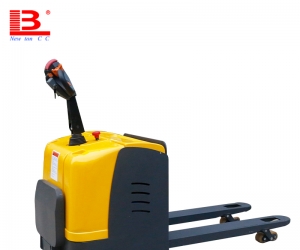
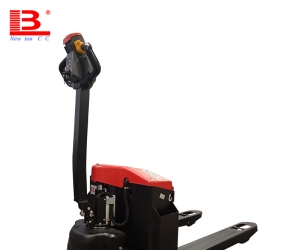
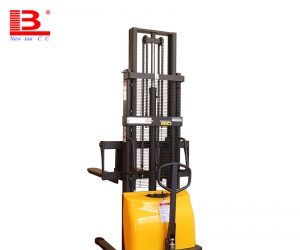
Many people don’t know how to choose between walk-behind and ride-on stackers, especially when it comes to counterbalance designs—they’re unsure about the specific differences. To help you better judge these two types of stackers when purchasing, we’ve conducted a detailed walk-behind vs ride-on counterbalance stacker comparison. We hope that by understanding their parameters and advantages, you can choose the right stacker for your needs.
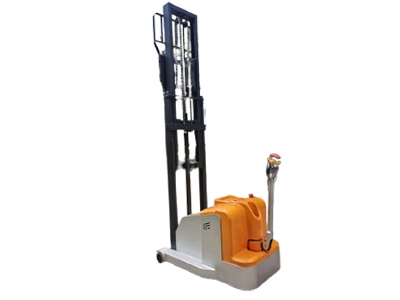
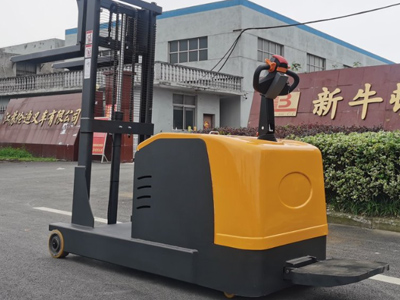
Ride-On Counterbalance Stacker
The rated load usually ranges from 0.5 tons to 3 tons, and the lifting height can reach 6 meters.
Its main advantage is the ride-on operation, which is more labor-saving and does not easily block the operator’s view, improving overall work efficiency. The ride-on counterbalance stacker has low operation intensity, allowing operators to work longer and more accurately. It is equipped with a large-capacity maintenance-free battery and a legless design, suitable for various pallets.
Walk-Behind Stacker
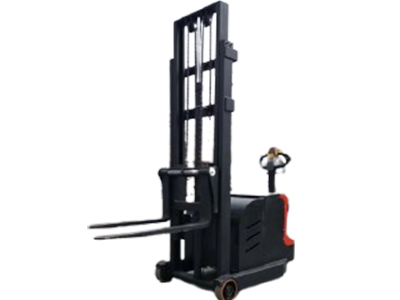
The rated load usually ranges from 0.5 tons to 1 ton, and the lifting height can reach 3 meters.
Its main advantage is the walk-behind operation; the whole machine is designed to be more compact and small, able to adapt to more narrow aisles and small-space operation scenarios. The work efficiency of this stacker is lower than that of the ride-on type—after all, the parameters speak for themselves—but it is superior in flexibility. In addition, its battery and legless design are the same as those of the ride-on type.
It can be seen that neither of these two stackers is “better” than the other; it all depends on which one better matches your current operation scenarios and needs. For small spaces, narrow aisles, and short handling distances, the walk-behind type is more suitable. For wider aisles, large handling volume, and pursuit of efficiency, the ride-on counterbalance stacker is the right choice.
Through this walk-behind vs ride-on counterbalance stacker comparison, you should now know how to choose. If you have any questions about purchasing stackers, feel free to leave a message to discuss!
-
 Reliability Of Newnewton Warehouse Forklifts For Heavy-Duty ShiftsWarehouse forklift reliability relies on industrial parts, reinforced frames and factory durability tests. Proper operation and maintenance reduce unexpected downtime.
Do you like ?0
Read more -
 Forklift Configuration Strategy For Dense Warehousing, Warehouse ForkliftDense warehousing needs matched forklifts besides racks. Reach and trilateral stackers fit different layouts, coordinate aisle, load curve and floor for smooth handling.
Do you like ?0
Read more -
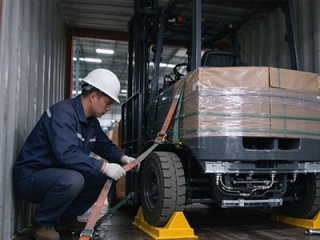 Full Container Supply For Export Forklifts, Forklift ManufacturerBulk forklift orders for overseas can ship by FCL or LCL. Newnewton FCL offers stable freight, safer packing and mixed models for large purchases.
Do you like ?0
Read more -
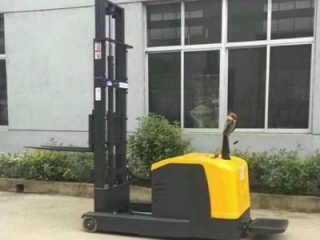 Stand-on Reach Stacker For Narrow Aisle Stacking, Mast Reach StructureStand-on reach stackers feature sliding masts that stay outside racks. They boost storage density in narrow aisles and require flat floors and standard pallets.
Do you like ?0
Read more -
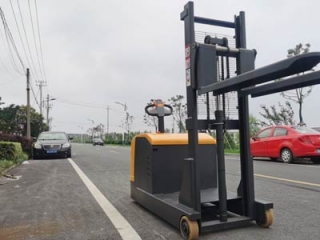 Stand-on Counterbalance Stacker For Various Pallets, Why No Leg RestrictionCounterbalance stackers have no front outriggers, using rear counterweight to avoid pallet interference. They fit various odd pallets yet need wider warehouse aisles.
Do you like ?0
Read more -
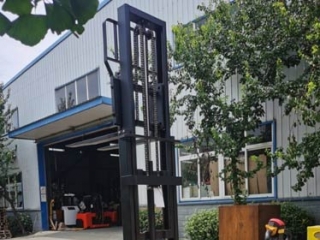 Custom Walk-Behind Counterbalance Stacker | Non-Standard ModificationsStandard walk-behind counterbalance stackers struggle with non-standard pallets and tight aisles. Customize load, lift, forks and structure, share working conditions for safe design.
Do you like ?0
Read more