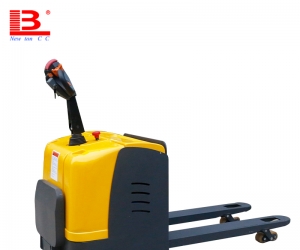
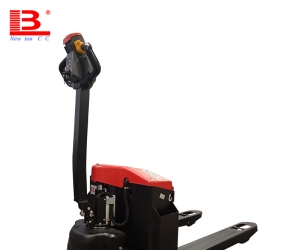
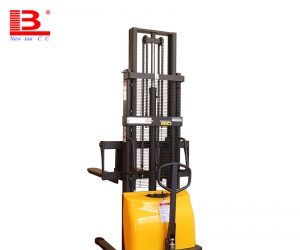
Is Stand-on Counterbalance Stacker Hard To Operate? 3 Simple Operation Steps
Many warehouse managers assume that counterbalance stackers hard to operate, which requires professional training and licenses. In fact, this Counterbalance Stacker features highly integrated control handles with simple operation logic. Warehouse staff with zero experience can master it quickly after short practice. Follow these three steps to operate the truck proficiently.
Step 1: Board and Align, Drive Into Pallet Position At Low Speed
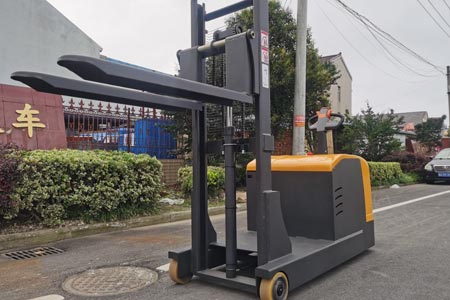
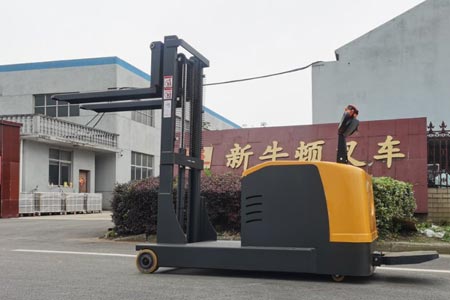
Stand firmly on the anti-slip platform and check for pedestrians and obstacles around the truck before releasing the handbrake. Switch the travel gear to low speed, grip the control handle and move forward or backward slowly. This counterbalance model has a long rear counterweight, so reserve sufficient turning space and avoid driving too close to rack uprights. Adjust the vehicle to center the forks with the pallet, keep forks horizontal and slide them fully into the pallet opening without one-sided deviation. Important reminder: Never lift cargo until forks are fully inserted to prevent pallet sliding.
Step 2: Lift and Stack Steadily, Control Center of Gravity Against Tipping
After full fork insertion, lift the pallet roughly 10cm off the ground and check if the load stays centered without tilting. Drive slowly to the rack position, straighten the whole truck before further lifting. Once reaching the target height, wait for the truck to stop completely, then move forward gently to place goods into position. Sharp turns and sudden braking are strictly forbidden with elevated loads. The stability of the counterbalance stacker relies on rear weight; the higher the lifting height, the slower the turning speed. Lower the forks fully before reversing out after finishing placement.
Step 3: Unload and Park Properly to Protect The Equipment
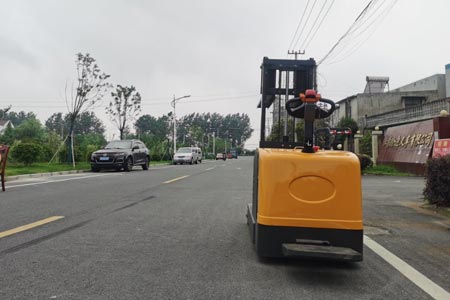
After loading or unloading, lower forks all the way down and never leave them suspended. Reverse slowly out of the aisle and park the truck in the designated area clear of traffic lanes. Return the handle to neutral, pull on the handbrake and cut off the power. Disconnect the main power supply during long idle time to prevent battery drain.
The Stand-on Counterbalance Stacker is quite user-friendly. The stand-up structure delivers a wider field of vision, so operators can respond promptly to barriers. Four basic safety rules for daily operation:
Never overload or place all weight on one side of the forks.
Slow down on bumpy or slippery ground. Do not turn or lift forks on ramps.
Drive backward at low speed if tall cargo blocks your front view.
Keep your whole body inside the truck frame to avoid collision with racks.
-
 Reliability Of Newnewton Warehouse Forklifts For Heavy-Duty ShiftsWarehouse forklift reliability relies on industrial parts, reinforced frames and factory durability tests. Proper operation and maintenance reduce unexpected downtime.
Do you like ?0
Read more -
 Forklift Configuration Strategy For Dense Warehousing, Warehouse ForkliftDense warehousing needs matched forklifts besides racks. Reach and trilateral stackers fit different layouts, coordinate aisle, load curve and floor for smooth handling.
Do you like ?0
Read more -
 Full Container Supply For Export Forklifts, Forklift ManufacturerBulk forklift orders for overseas can ship by FCL or LCL. Newnewton FCL offers stable freight, safer packing and mixed models for large purchases.
Do you like ?0
Read more -
 Stand-on Reach Stacker For Narrow Aisle Stacking, Mast Reach StructureStand-on reach stackers feature sliding masts that stay outside racks. They boost storage density in narrow aisles and require flat floors and standard pallets.
Do you like ?0
Read more -
 Stand-on Counterbalance Stacker For Various Pallets, Why No Leg RestrictionCounterbalance stackers have no front outriggers, using rear counterweight to avoid pallet interference. They fit various odd pallets yet need wider warehouse aisles.
Do you like ?0
Read more -
 Custom Walk-Behind Counterbalance Stacker | Non-Standard ModificationsStandard walk-behind counterbalance stackers struggle with non-standard pallets and tight aisles. Customize load, lift, forks and structure, share working conditions for safe design.
Do you like ?0
Read more