
304 VS 316 Stainless Steel Manual Pallet Truck: Material Difference
For working sites such as food processing plants, chemical factories and pharmaceutical workshops, stainless‑steel material is preferred for pallet trucks. 304 and 316 are the two mainstream stainless‑steel grades. Though hard to tell apart by appearance, they show obvious gaps in practical performance including corrosion resistance, cost and applicable working conditions. Wrong material selection leads to rust damage and shortened service life. This article illustrates the difference between 304 and 316 stainless steel manual pallet truck in detail.
304 stainless steel is a nickel‑chromium alloy with basic anti‑rust performance. It resists water vapor, ordinary water mist and routine washing environments and contains no molybdenum element. It will suffer pitting corrosion and rust spots under long‑term exposure to chloride ions, salt spray or weak acid‑base media.
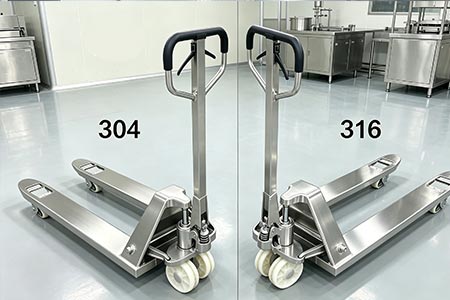
Built upon 304 formulation, 316 stainless steel adds molybdenum. Molybdenum greatly improves resistance against chloride‑ion erosion. It delivers much better performance against salt spray, seawater and weak acid‑base substances with stronger pitting‑corrosion resistance.
Material grade brings obvious price gaps. Take identical 2‑ton stainless‑steel manual hydraulic pallet jack as reference: ‑ 304 stainless steel manual pallet truck: $382‑$500 ‑ 316 stainless steel manual pallet truck: $559‑$706
Higher raw‑material cost makes 316 models roughly 40 % more expensive than 304 versions. Distributor retail prices will rise further on this basis.
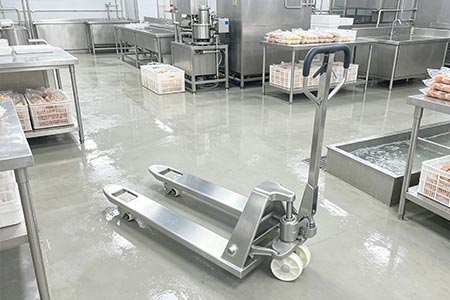
Suitable scenarios for 304 stainless‑steel manual pallet jack ‑ Food workshops and pharmaceutical clean workshops with fresh‑water washing, no salt or chemical liquid exposure ‑ Ordinary humid indoor premises and cold‑storage rooms without salt‑water spraying ‑ Wine and beverage processing workshops only exposed to clean water and regular food raw materials ‑ Projects with limited budget where only basic rust‑proof capability is required and no chloride‑ion corrosion exists
Unsuitable scenarios: coastal salt‑spray environment, chemical workshops, salt‑water washing and sites with high‑concentration chloride‑containing disinfectants.
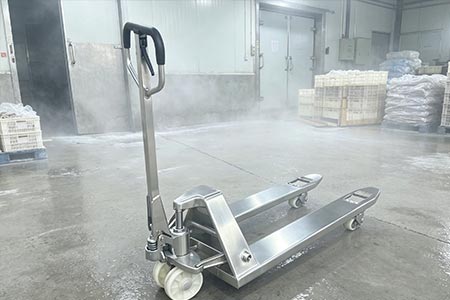
Suitable scenarios for 316 stainless‑steel manual pallet jack ‑ Seafood‑processing workshops and coastal warehouses with salt‑laden air ‑ Chemical and electroplating workshops exposed to weak acid‑base media ‑ Pharmaceutical and food stations requiring frequent disinfection washing with chlorine‑based disinfectants ‑ Salted‑food processing where equipment contacts salt water
To sum up, choose the right stainless‑steel manual hydraulic pallet jack according to your actual site conditions. If you are uncertain about material selection, share your on‑site environment, exposure to salt or chemical reagents and required load capacity. We will provide accurate model suggestions and quotation references.
-
 Reliability Of Newnewton Warehouse Forklifts For Heavy-Duty ShiftsWarehouse forklift reliability relies on industrial parts, reinforced frames and factory durability tests. Proper operation and maintenance reduce unexpected downtime.
Do you like ?0
Read more -
 Forklift Configuration Strategy For Dense Warehousing, Warehouse ForkliftDense warehousing needs matched forklifts besides racks. Reach and trilateral stackers fit different layouts, coordinate aisle, load curve and floor for smooth handling.
Do you like ?0
Read more -
 Full Container Supply For Export Forklifts, Forklift ManufacturerBulk forklift orders for overseas can ship by FCL or LCL. Newnewton FCL offers stable freight, safer packing and mixed models for large purchases.
Do you like ?0
Read more -
 Stand-on Reach Stacker For Narrow Aisle Stacking, Mast Reach StructureStand-on reach stackers feature sliding masts that stay outside racks. They boost storage density in narrow aisles and require flat floors and standard pallets.
Do you like ?0
Read more -
 Stand-on Counterbalance Stacker For Various Pallets, Why No Leg RestrictionCounterbalance stackers have no front outriggers, using rear counterweight to avoid pallet interference. They fit various odd pallets yet need wider warehouse aisles.
Do you like ?0
Read more -
 Custom Walk-Behind Counterbalance Stacker | Non-Standard ModificationsStandard walk-behind counterbalance stackers struggle with non-standard pallets and tight aisles. Customize load, lift, forks and structure, share working conditions for safe design.
Do you like ?0
Read more








