Why Choose 4WD Rough Terrain Forklift For Mountain & Slope Handling Work
Standard warehouse forklifts cannot handle sloped terrain well and face high risks of turnover and sliding when transporting goods on mountain slopes. Many construction sites, orchards and open gravel yards make purchasing mistakes. If indoor warehouse forklifts are deployed on outdoor slopes, issues such as spinning drive wheels, vehicle sliding and chassis grounding will occur frequently. The ideal solution is to select qualified mountain off-road forklift.
Most indoor forklifts adopt two-wheel drive. The shift of center of gravity during slope start reduces pressure on drive wheels, which easily causes wheel spin. The 4WD all-terrain forklift is equipped with four-wheel synchronous drive system, and optional part-time four-wheel drive mode. On slopes and slippery muddy ground, four wheels output power simultaneously. When one wheel slips, other tires can still provide traction, greatly reducing risks of sliding and stalling.
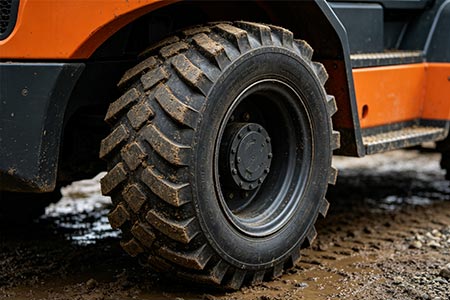
Conventional counterbalance forklifts usually have only 100–150 mm loaded ground clearance. Potholes and gravel on the ground are likely to scratch the chassis and oil pipelines. The 4WD all-terrain forklift generally achieves loaded ground clearance above 260 mm, with larger approach and departure angles. It can smoothly cross mounds, gravel and shallow pits to prevent chassis damage. For long-term work on muddy ground after rain, the elevated chassis reduces mud accumulation, protects hydraulic pipelines and transmission assemblies and extends service life.
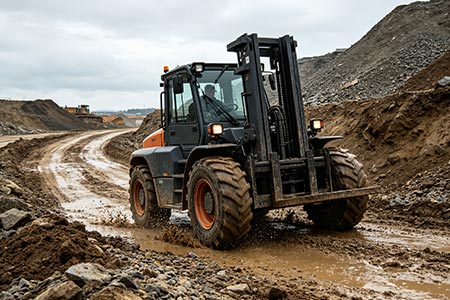
Indoor forklifts are normally fitted with PU wheels and shallow-pattern solid tires. Once covered with mud, these tires lose nearly all traction. The mountain off-road forklift comes standard with large-diameter deep-groove pneumatic or semi-solid off-road tires. The open tread realizes automatic mud removal. Larger tire contact area lowers ground pressure to avoid sinking on soft soil.
The excellent climbing capacity of 4WD all-terrain forklift originates from high ground clearance, four-wheel drive and deep-tread tires. When working on mountain terrain, the equipment delivers stable performance and guarantees cargo safety to bring reliable operation experience.
-
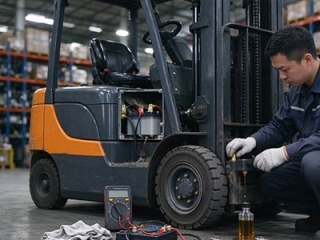 Reliability Of Newnewton Warehouse Forklifts For Heavy-Duty ShiftsWarehouse forklift reliability relies on industrial parts, reinforced frames and factory durability tests. Proper operation and maintenance reduce unexpected downtime.
Do you like ?0
Read more -
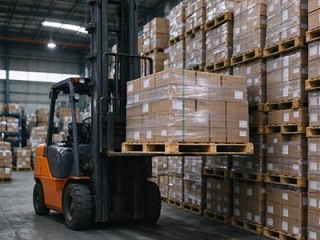 Forklift Configuration Strategy For Dense Warehousing, Warehouse ForkliftDense warehousing needs matched forklifts besides racks. Reach and trilateral stackers fit different layouts, coordinate aisle, load curve and floor for smooth handling.
Do you like ?0
Read more -
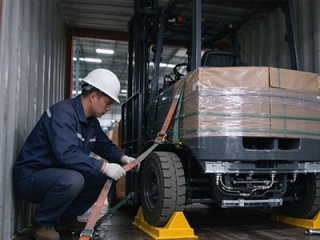 Full Container Supply For Export Forklifts, Forklift ManufacturerBulk forklift orders for overseas can ship by FCL or LCL. Newnewton FCL offers stable freight, safer packing and mixed models for large purchases.
Do you like ?0
Read more -
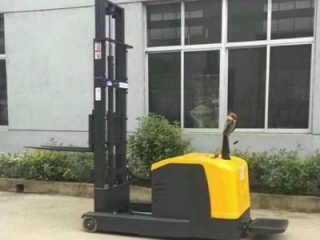 Stand-on Reach Stacker For Narrow Aisle Stacking, Mast Reach StructureStand-on reach stackers feature sliding masts that stay outside racks. They boost storage density in narrow aisles and require flat floors and standard pallets.
Do you like ?0
Read more -
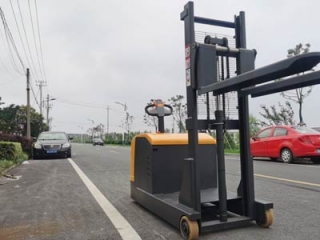 Stand-on Counterbalance Stacker For Various Pallets, Why No Leg RestrictionCounterbalance stackers have no front outriggers, using rear counterweight to avoid pallet interference. They fit various odd pallets yet need wider warehouse aisles.
Do you like ?0
Read more -
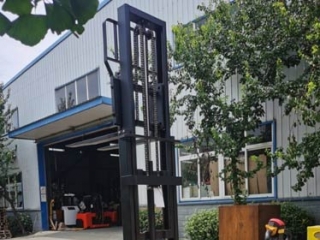 Custom Walk-Behind Counterbalance Stacker | Non-Standard ModificationsStandard walk-behind counterbalance stackers struggle with non-standard pallets and tight aisles. Customize load, lift, forks and structure, share working conditions for safe design.
Do you like ?0
Read more