PWM Speed Control Principle Of Forklift Motor | CURTIS Controller
Most electric forklifts adopt PWM pulse width modulation for stepless speed regulation, which is the core technology of CURTIS controllers. Many practitioners only know the controller but lack knowledge of its working logic. This article fully explains the PWM Speed Control Principle Of Forklift Motor.
Definition of PWM Speed Regulation
PWM stands for Pulse Width Modulation. The controller outputs high-frequency intermittent DC power with fixed voltage but adjustable duty cycle:
Slightly turn the handle: Short power-on time, long power-off time, low average power, motor runs at low speed;
Push the handle to full speed: Duty cycle close to 100%, average voltage reaches rated value, motor operates at full speed.
In short, the system switches power on and off rapidly. By adjusting the power-on duration, it smoothly changes the average motor speed to realize stepless speed control.
Complete Control Logic of Electric Forklift
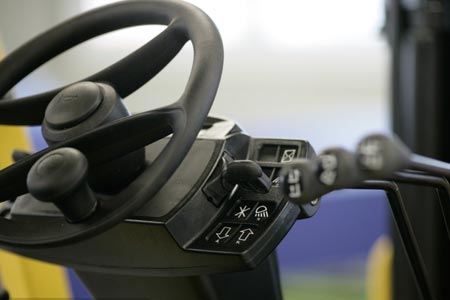
The operating handle sends a 0–5V analog signal to the controller mainboard;
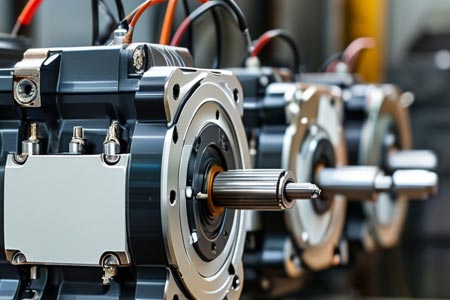
The mainboard calculates the matching pulse duty cycle according to signal value;
High-power MOS tubes switch on and off at high frequency to deliver intermittent pulse power to the DC motor;
The motor armature receives continuously variable average voltage, enabling smooth speed adjustment without gears;
Freewheeling diodes absorb reverse voltage generated during power-off to prevent controller breakdown.
Advantages of PWM Over Traditional Resistance Speed Regulation
Energy-saving: No heat loss from resistors, battery runtime increased by 12%-18%;
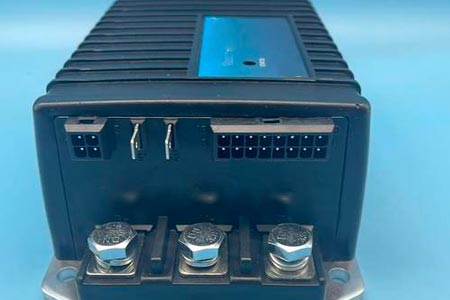
Smooth operation: No sudden jerk on startup to avoid cargo tipping;
Lower failure rate: Low controller temperature, rarely triggers thermal protection during long shifts;
Stable torque: Sufficient traction at low speed for climbing and heavy loads.
Actual Test Data
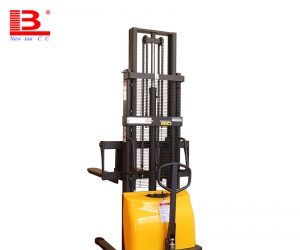
On the same walk-behind stacker equipped with a PWM controller, the controller surface temperature stays below 55℃ after 4 hours of continuous operation. Under identical working conditions, old resistance-type controllers exceed 80℃ and frequently shut down due to overheating protection.
Energy efficiency, smooth startup and low heat generation of Electric Forklift all rely on the PWM control system. Feel free to leave your technical questions below.
-
 Reliability Of Newnewton Warehouse Forklifts For Heavy-Duty ShiftsWarehouse forklift reliability relies on industrial parts, reinforced frames and factory durability tests. Proper operation and maintenance reduce unexpected downtime.
Do you like ?0
Read more -
 Forklift Configuration Strategy For Dense Warehousing, Warehouse ForkliftDense warehousing needs matched forklifts besides racks. Reach and trilateral stackers fit different layouts, coordinate aisle, load curve and floor for smooth handling.
Do you like ?0
Read more -
 Full Container Supply For Export Forklifts, Forklift ManufacturerBulk forklift orders for overseas can ship by FCL or LCL. Newnewton FCL offers stable freight, safer packing and mixed models for large purchases.
Do you like ?0
Read more -
 Stand-on Reach Stacker For Narrow Aisle Stacking, Mast Reach StructureStand-on reach stackers feature sliding masts that stay outside racks. They boost storage density in narrow aisles and require flat floors and standard pallets.
Do you like ?0
Read more -
 Stand-on Counterbalance Stacker For Various Pallets, Why No Leg RestrictionCounterbalance stackers have no front outriggers, using rear counterweight to avoid pallet interference. They fit various odd pallets yet need wider warehouse aisles.
Do you like ?0
Read more -
 Custom Walk-Behind Counterbalance Stacker | Non-Standard ModificationsStandard walk-behind counterbalance stackers struggle with non-standard pallets and tight aisles. Customize load, lift, forks and structure, share working conditions for safe design.
Do you like ?0
Read more