
High-level Stacking Safety Notes for Electric Three-way Forklift
High-level stacking carries high risks in narrow aisle warehouses. Full electric three-way forklifts can store and retrieve goods at high positions within tight rack aisles. However, operators have limited sightlines during high-lift work. Improper operation may lead to rack collision and cargo falling, which can trigger safety accidents. Mastering safety operation procedures of full electric three-way forklift is critical for operations in stereoscopic warehouses.
Pre-operation inspection for truck and site Before startup, check wheels for damage, inspect masts and forks for cracks or deformation. Test lifting, lowering and three-way rotation functions. Make sure emergency stop and audible & visual warning devices work properly. Check the aisle in advance and clear scattered pallets and packaging debris to remove obstacles. Verify cargo weight and never operate with overload.
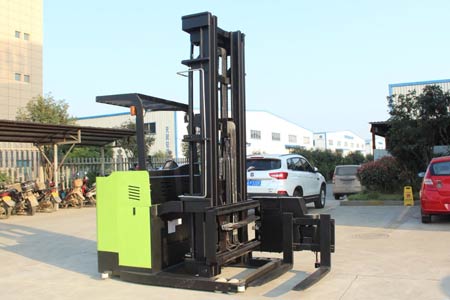
Basic rules for travelling in aisles Drive at low speed inside aisles and maintain safe clearance from racks on both sides. Sharp turning and sudden braking are prohibited. Keep forks lowered while travelling, only lift forks when reaching the target rack position. For stereoscopic warehouses with multiple operators, manage aisle traffic. Avoid two three-way forklifts meeting in the same narrow aisle.
Key points for high-level stacking and picking Align forks with pallet openings and insert forks horizontally and smoothly. Do not insert forks at an angle or push hard. After lifting cargo to the required rack height, slowly rotate the forks sideways for alignment. Push forks gently to place cargo once aligned. When picking goods, confirm the pallet sits firmly. Retract forks and lower the mast only after the cargo is fully supported. Fast fork rotation at high lifting height is forbidden to prevent cargo slipping.
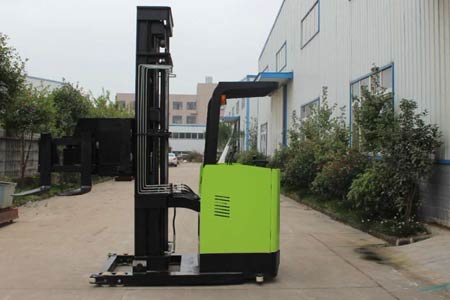
Safety prohibitions during operation Do not travel long distances with forks raised. Avoid high stacking if cargo center of gravity shifts or pallets are broken and deformed. Never stand on forks or pallets to work at height, and do not lean against racks while operating the truck. Stop operation and cut off power immediately if abnormal noise, hydraulic leakage or electrical alarms occur. Exit the aisle for maintenance. Do not continue running faulty equipment.
Post-operation procedures After finishing work, lower forks fully to the bottom position and retract the fork rotation mechanism. Park the truck in the designated safe zone. Turn off power and activate the emergency stop switch. Clean debris on forks and complete daily operation records of the truck.
Learning all precautions for high-level stacking with electric three-way forklift covering pre-operation, in-operation and post-operation stages helps ensure safe and efficient work and reduce accident risks.
-
 Reliability Of Newnewton Warehouse Forklifts For Heavy-Duty ShiftsWarehouse forklift reliability relies on industrial parts, reinforced frames and factory durability tests. Proper operation and maintenance reduce unexpected downtime.
Do you like ?0
Read more -
 Forklift Configuration Strategy For Dense Warehousing, Warehouse ForkliftDense warehousing needs matched forklifts besides racks. Reach and trilateral stackers fit different layouts, coordinate aisle, load curve and floor for smooth handling.
Do you like ?0
Read more -
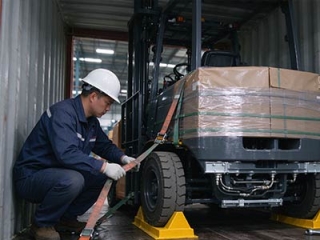 Full Container Supply For Export Forklifts, Forklift ManufacturerBulk forklift orders for overseas can ship by FCL or LCL. Newnewton FCL offers stable freight, safer packing and mixed models for large purchases.
Do you like ?0
Read more -
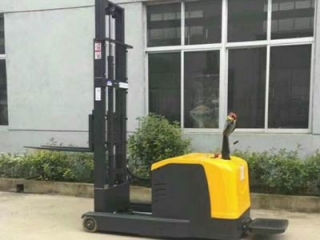 Stand-on Reach Stacker For Narrow Aisle Stacking, Mast Reach StructureStand-on reach stackers feature sliding masts that stay outside racks. They boost storage density in narrow aisles and require flat floors and standard pallets.
Do you like ?0
Read more -
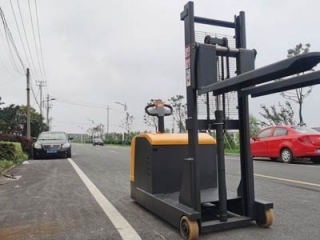 Stand-on Counterbalance Stacker For Various Pallets, Why No Leg RestrictionCounterbalance stackers have no front outriggers, using rear counterweight to avoid pallet interference. They fit various odd pallets yet need wider warehouse aisles.
Do you like ?0
Read more -
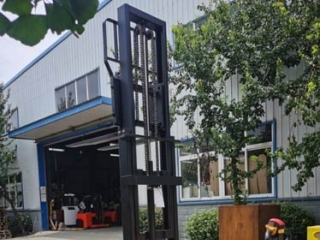 Custom Walk-Behind Counterbalance Stacker | Non-Standard ModificationsStandard walk-behind counterbalance stackers struggle with non-standard pallets and tight aisles. Customize load, lift, forks and structure, share working conditions for safe design.
Do you like ?0
Read more








