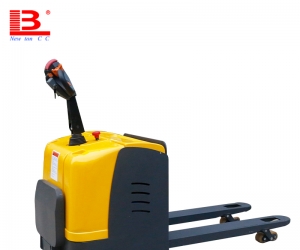
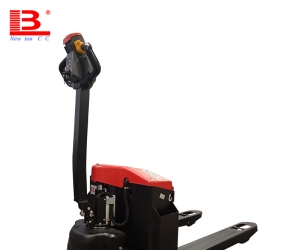
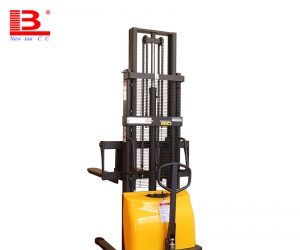
The working device is the working part of an electric forklift for loading and unloading operations, which bears all the weight of the goods and completes the processes of forking, lifting, stacking, and stacking of the goods. The working devices of electric forklifts vary depending on the type of forklift, and are usually divided into two categories: gantry type working devices and forward extension type working devices. The forward extension working device can also be divided into a connecting rod type and a telescopic arm type (also known as a gantry less type). Forklift manufacturer tells everyone that balanced weight forklifts belong to gantry forklifts, and their working devices mainly consist of pick-up devices (forks and forks), gantry frames, lifting mechanisms, gantry tilt mechanisms, and hydraulic transmission systems.
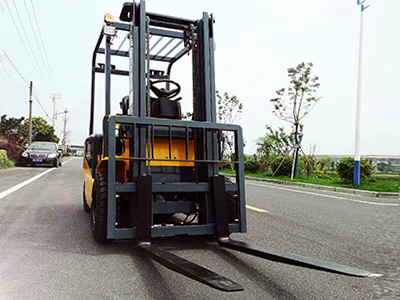
The gantry of an electric forklift is the framework of the lifting mechanism and also the guide rail for the movement of the forklift. In order to achieve a certain lifting height for the goods, and to reduce the overall dimensions, the forklift gantry can be made into a retractable type through warehouse doors, truck doors, or workshop access doors. The gantry of most forklifts is a two-stage gantry, with the outer section usually not lifting and called the outer gantry; The inner section can retract up and down along the outer gantry, known as the inner gantry. For forklifts with large lifting heights, they can be made into a three stage gantry with two stages that can be retracted. The outer gantry is hinged to the frame or front axle with its lower crossbeam, forming a hinged support for the gantry's tilt motion; The other fulcrum of the outer gantry is hinged to the frame through a tilting mechanism. Forklift manufacturer tells everyone that the core device of the gantry tilt mechanism is the tilt cylinder. The expansion and contraction of the tilt cylinder realizes the forward and backward tilt of the gantry, that is, the forward and backward tilt of the forks, making it easy for the forks to pick up and stack goods, and ensuring that the goods remain stable on the forks during forklift movement and do not slip off the goods during braking.
The lifting mechanism of electric forklift consists of lifting cylinders, guide pulleys and wheel frames, lifting chains, and forks. The lifting oil cylinder is installed on the lower crossbeam of the outer gantry. The upper end of the piston rod of the oil cylinder is connected to the wheel frame, and the guide pulley is installed on the wheel frame. A lifting chain is wound around the guide pulley, with one end fixed to the oil cylinder cover (or gantry crossbeam) and the other end connected to the fork frame by bypassing the guide pulley. The lifting oil cylinder lifts the guide pulley, which drives the chain through the pulley, and the chain pulls the fork frame to raise and lower it. Forklift manufacturer tells everyone that forks or other pick-up devices are installed on forks to achieve the lifting and lowering of goods.
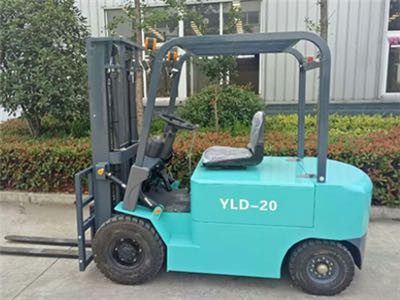
The lifting and tilting actions of the gantry and fork of an electric forklift are all executed by various working oil cylinders. The working device of a balanced forklift is installed at the forefront of the forklift to facilitate loading and unloading operations. Forklift manufacturer tells everyone that forward moving forklifts have a gantry forward movement mechanism, and some are also equipped with a pitching mechanism for forks.
-
 Reliability Of Newnewton Warehouse Forklifts For Heavy-Duty ShiftsWarehouse forklift reliability relies on industrial parts, reinforced frames and factory durability tests. Proper operation and maintenance reduce unexpected downtime.
Do you like ?0
Read more -
 Forklift Configuration Strategy For Dense Warehousing, Warehouse ForkliftDense warehousing needs matched forklifts besides racks. Reach and trilateral stackers fit different layouts, coordinate aisle, load curve and floor for smooth handling.
Do you like ?0
Read more -
 Full Container Supply For Export Forklifts, Forklift ManufacturerBulk forklift orders for overseas can ship by FCL or LCL. Newnewton FCL offers stable freight, safer packing and mixed models for large purchases.
Do you like ?0
Read more -
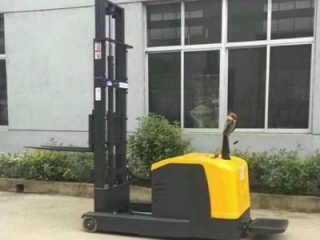 Stand-on Reach Stacker For Narrow Aisle Stacking, Mast Reach StructureStand-on reach stackers feature sliding masts that stay outside racks. They boost storage density in narrow aisles and require flat floors and standard pallets.
Do you like ?0
Read more -
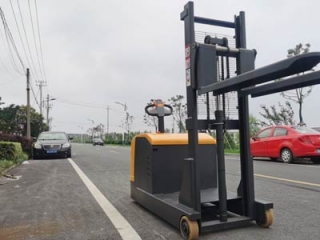 Stand-on Counterbalance Stacker For Various Pallets, Why No Leg RestrictionCounterbalance stackers have no front outriggers, using rear counterweight to avoid pallet interference. They fit various odd pallets yet need wider warehouse aisles.
Do you like ?0
Read more -
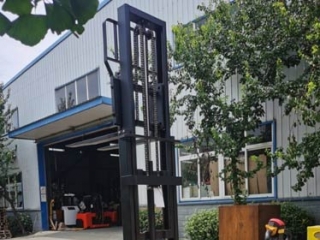 Custom Walk-Behind Counterbalance Stacker | Non-Standard ModificationsStandard walk-behind counterbalance stackers struggle with non-standard pallets and tight aisles. Customize load, lift, forks and structure, share working conditions for safe design.
Do you like ?0
Read more