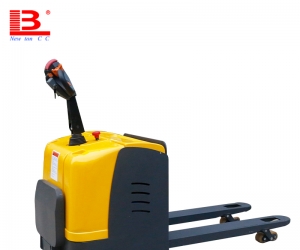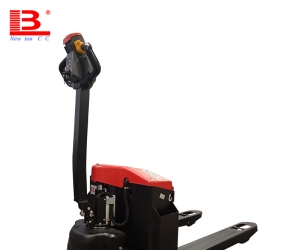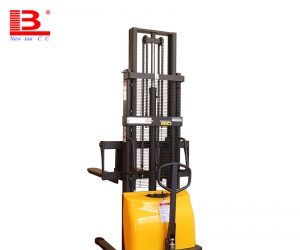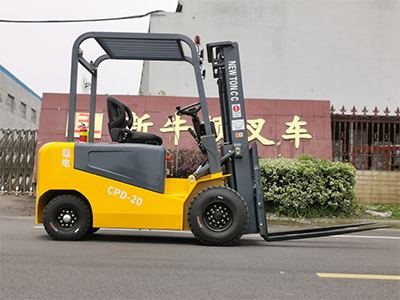
(1) The starting process of electric forklifts and tractors.
Starting is the most basic and frequently used operation of forklift driving, and the quality of starting directly affects the efficiency of forklift operation, the safety of goods, and the service life of machinery.
When starting electric forklifts and tractors, the upper body should be kept upright and natural, with both eyes fixed on the cargo stack and the road conditions in the direction of travel. The specific operation method is: when starting, the emergency switch should be turned on, the electric lock should be turned on, and then the direction switch should be turned on, the horn should sound, and then slowly start and gradually accelerate.
(2) How to operate electric forklifts and tractors in a straight line?
1. Move forward. Driving posture should be upright, looking ahead, looking far and near, and paying attention to both sides. Correctly operate the steering wheel, with the left hand as the main force and the right hand as the auxiliary force. Pull with one hand and push with the other hand, closely cooperating.
During driving, the uneven road surface can easily cause the steering wheel to be impacted and vibrated, resulting in deviation. It is necessary to correct the direction in a timely manner. When the front of the car deviates to the left (right), the square wheel should be turned towards (). When the front of the car approaches the driving route, gradually turn the steering wheel back to the right. When correcting the direction, it is important to hit less and return less, especially after the forklift. The characteristics of wheel steering prevent forklifts from "drawing a dragon" and carefully experience the clearance of the steering wheel. When a forklift is driving on the right side of the road, to prevent rightward deviation, the clearance should be left on the right side of the steering wheel.
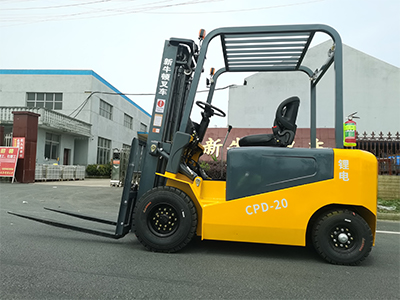
2. Reverse. In the driving of electric forklifts or tractors, the usage rate of "reverse" is not as high as "forward", but far higher than other vehicles. Correct and proficient reverse operation plays a crucial role in improving the efficiency of forklift and tractor operations.
For forklifts with the driver's seat on the left, when reversing for a long distance, the left hand should hold the steering wheel, the body should sit diagonally to the right, the right arm should be supported on the backrest, the head should be turned back, and both eyes should be fixed on the situation behind and the cargo pile. Before reversing, one should first see the surrounding situation, select a forward and backward route, issue a reverse signal, and sound the horn to attract the attention of other vehicles and pedestrians. It is necessary to control the speed of the vehicle during reverse, and avoid sudden changes in speed to prevent danger caused by excessive reverse speed.
(3) Parking Techniques for Electric Forklifts and Tractors
The general stopping actions of a forklift during operation are as follows:
1. Relax the accelerator pedal, and according to the situation, use methods such as immediately fully lowering, gently stepping down, gradually increasing, and releasing as you step, to achieve the goal of slowing down or stopping.
2. Tighten the handbrake lever, lower the fork to the lowest position, turn off the electric lock switch, and unplug the battery connection plug.
The key to a smooth parking is to use appropriate and uniform force to step on the brake pedal according to the speed of the vehicle. Especially when the forklift or tractor is about to stop, it is necessary to release the pedal appropriately, and then apply a little pressure. The forklift or tractor can stop smoothly.
-
 Newnewton Forklift Manufacturer, Forklift CE Certification for ExportNewnewton forklift factory offers full CE certification complying with EN ISO 3691, complete technical documents and OEM service to reduce customs detention risks.
Do you like ?0
Read more -
 Electric Forklift Vs Diesel Forklift, Warehouse Selection GuideElectric forklift is zero-emission and quiet for indoor clean warehouses. Diesel forklift offers strong power for outdoor heavy-duty tasks.
Do you like ?0
Read more -
 Narrow Aisle Stacker Forklift Custom Manufacturer for WarehouseCustom narrow aisle stacker for non-standard racking. Adjust body, mast and fork specs, upgrade power and protection, site survey available.
Do you like ?0
Read more -
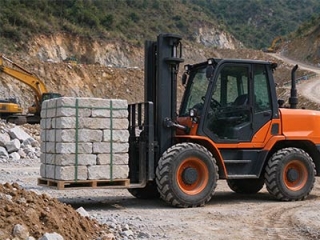 4WD All Terrain Rough Terrain Forklift Climbing for Mountain Sites4WD rough terrain forklift works on unpaved roads. Observe load climbing limit, attachments optional for forest and construction sites.
Do you like ?0
Read more -
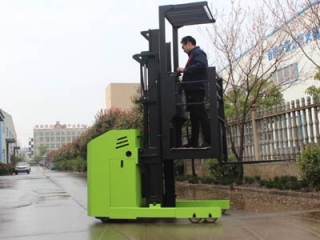 Man-Up Order Picker for High Level Picking, Suitable Warehouse ModesMan-up high level order picker for high-level split picking. Not for full pallet stacking, check rack, aisle and floor before selection.
Do you like ?0
Read more -
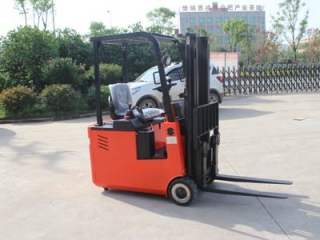 Narrow Aisle Operation Of Three-Wheel Forklift With Compact Turning RadiusThree-point electric forklift features small turning radius for narrow aisles. Reserve safety margin and check floor condition during selection.
Do you like ?0
Read more