Which Battery For 4 Wheel Electric Forklift? Working Condition Comparison
The battery is the core component of the Four-wheel Electric Forklift. Proper battery selection directly affects service life, runtime and power performance. There is no universal best solution; the choice depends on your actual working conditions. This article compares two mainstream traction batteries, analyzes applicable scenarios and sorts out key selection criteria.
Lead-acid Battery
Lead-acid batteries are the traditional power option for early four-wheel electric forklifts with mature technology and widely available spare parts.
Procurement Cost: Lower upfront investment for equal capacity, reducing initial capital pressure.
Maintenance Requirement: Non-sealed types require regular electrolyte inspection and distilled water topping-up. Hydrogen is released during charging; charging areas must be well ventilated. Charging inside enclosed rooms is prohibited.
Charge & Discharge Performance: Not suitable for opportunity charging. A full charge takes 8–10 hours; short break top-up is not recommended. Continuous high-current discharge performance is moderate.
Cycle Life: 500–1000 cycles normally, service life around 2–3 years under standard operation.
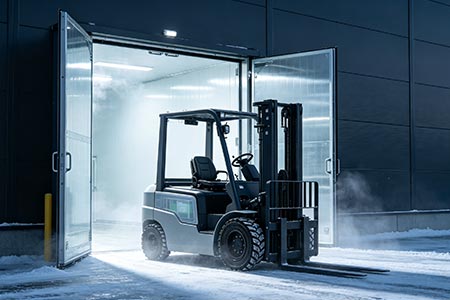
Low-temperature Performance: Significant capacity attenuation under cold conditions. Not recommended for long-term freezer operation.
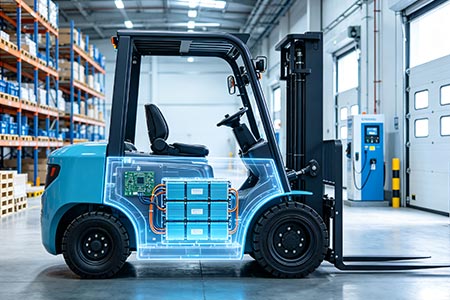
Lithium Iron Phosphate Battery
Sealed integrated LiFePO4 batteries are the preferred choice for high-frequency warehouses and export equipment. Two versions available: standard type and low-temperature preheating type for cold storage.
Procurement Cost: Higher initial purchase price compared with lead-acid batteries of equal capacity.
Maintenance Requirement: Completely maintenance-free. No electrolyte refilling needed. No hydrogen emission during charging, safe for food, electronics and clean workshops.
Charge & Discharge Performance: Supports fast charging and opportunity charging. Short charging during lunch breaks extends operation time, perfectly matching two-shift non-stop operation.
Cycle Life: 2000~3000 cycles, standardized service life of 5–8 years with fewer replacement cycles in long-term operation.
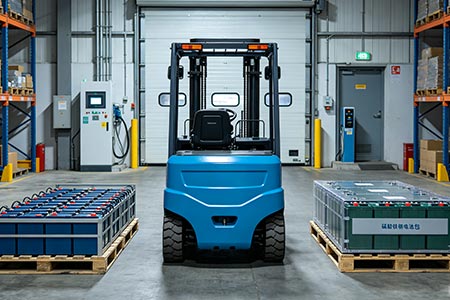
Low-temperature Performance: Optional version with built-in BMS preheating module, suitable for -18°C freezer working environments.
Both battery types for four-wheel electric forklifts have obvious advantages and drawbacks.
Choose lead-acid battery if: Single-shift operation, daily working hours 4–6 hours, moderate inbound & outbound volume, limited budget, no low-temperature working requirements.
Choose lithium iron phosphate battery if: Multi-shift continuous operation, high daily handling frequency, need opportunity charging, cleanroom / cold storage application, pursuing lower long-term replacement and maintenance costs.
In short, each battery technology has its own merits. You can make the decision according to your warehouse operation mode and site environment.
-
 Reliability Of Newnewton Warehouse Forklifts For Heavy-Duty ShiftsWarehouse forklift reliability relies on industrial parts, reinforced frames and factory durability tests. Proper operation and maintenance reduce unexpected downtime.
Do you like ?0
Read more -
 Forklift Configuration Strategy For Dense Warehousing, Warehouse ForkliftDense warehousing needs matched forklifts besides racks. Reach and trilateral stackers fit different layouts, coordinate aisle, load curve and floor for smooth handling.
Do you like ?0
Read more -
 Full Container Supply For Export Forklifts, Forklift ManufacturerBulk forklift orders for overseas can ship by FCL or LCL. Newnewton FCL offers stable freight, safer packing and mixed models for large purchases.
Do you like ?0
Read more -
 Stand-on Reach Stacker For Narrow Aisle Stacking, Mast Reach StructureStand-on reach stackers feature sliding masts that stay outside racks. They boost storage density in narrow aisles and require flat floors and standard pallets.
Do you like ?0
Read more -
 Stand-on Counterbalance Stacker For Various Pallets, Why No Leg RestrictionCounterbalance stackers have no front outriggers, using rear counterweight to avoid pallet interference. They fit various odd pallets yet need wider warehouse aisles.
Do you like ?0
Read more -
 Custom Walk-Behind Counterbalance Stacker | Non-Standard ModificationsStandard walk-behind counterbalance stackers struggle with non-standard pallets and tight aisles. Customize load, lift, forks and structure, share working conditions for safe design.
Do you like ?0
Read more