How To Extend Lithium Battery Life For Narrow Aisle Full Electric Stacker
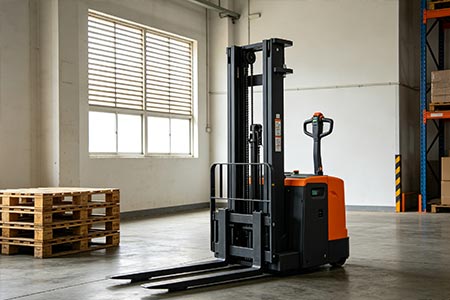
Do you use lithium-powered stackers in your warehouse? Proper maintenance is essential to achieve smooth operation and reduce breakdowns for equipment working inside narrow aisle racking. This guide covers key points of Lithium Electric Stacker Battery Maintenance to help you manage your Narrow Aisle Full Electric Stacker efficiently.
Key Lithium Battery Maintenance Guidelines
Standardized charging habits, avoid improper operation Always use the original dedicated lithium battery charger. Never use lead-acid battery chargers interchangeably. Recharge promptly when remaining power reaches 20%–30%. Avoid running the stacker until automatic shutdown due to fully drained power; deep discharge will permanently damage battery cells.
Disconnect power once fully charged to prevent long-term floating charge. For two-shift warehouses, arrange charging during rest intervals instead of continuous nonstop charging. Field tests show following this charging window can boost lithium battery cycle life by roughly 30%.
Control operating ambient temperature Optimal working temperature range for lithium batteries: 0℃–40℃. Prevent prolonged direct sunlight exposure during hot summer warehouse hours. In cold winter conditions, avoid full-load operation immediately; run the stacker at low speed for several minutes before high-lift stacking. Ventilation is limited between narrow aisle racks, so battery temperature rises rapidly during continuous operation. Stop periodically for heat dissipation after long high-intensity shifts.
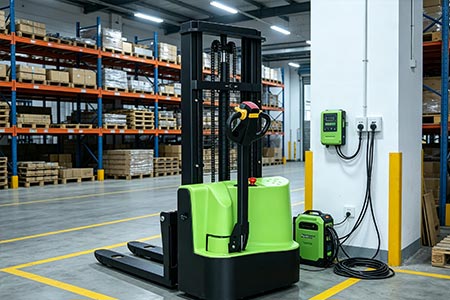
Standard requirements for long-term idle storage If equipment will be out of service for a long period, maintain battery charge at 40%–60%. Store indoors in dry and ventilated areas. Check voltage every 30 days and top up power when charge level drops too low. Do not store batteries at full charge or zero charge for extended time, which leads to cell imbalance. Keep batteries away from rain and damp floors to avoid terminal oxidation.
Daily visual inspection Before each shift, inspect battery casing for collision damage, check wiring harnesses for extrusion wear and loose terminals. Space is limited in narrow aisles; collisions frequently occur during turning. Stop operation immediately and conduct thorough inspection once battery housing is damaged. Do not continue using the unit.
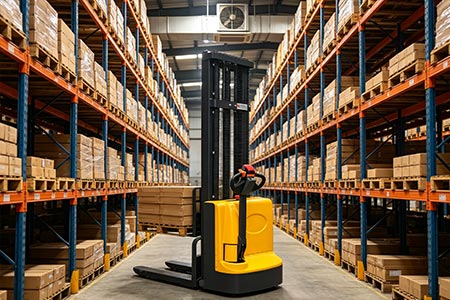
Operation Rules For Narrow Aisle Full Electric Stacker
Drive at low speed while traveling in narrow aisles. Lift and lower forks steadily during high-level stacking; avoid rapid fork movement. Minimize long-distance traveling with fully loaded forks. Heavy loads trigger high battery output current. Continuous high-current discharge accelerates heating and battery aging. Strictly follow rated load reduction data at high lifting heights; overloading is prohibited.
These specifications help extend the service life of the Narrow Aisle Full Electric Stacker and achieve reliable lithium battery maintenance for your warehouse material handling equipment.
-
 Reliability Of Newnewton Warehouse Forklifts For Heavy-Duty ShiftsWarehouse forklift reliability relies on industrial parts, reinforced frames and factory durability tests. Proper operation and maintenance reduce unexpected downtime.
Do you like ?0
Read more -
 Forklift Configuration Strategy For Dense Warehousing, Warehouse ForkliftDense warehousing needs matched forklifts besides racks. Reach and trilateral stackers fit different layouts, coordinate aisle, load curve and floor for smooth handling.
Do you like ?0
Read more -
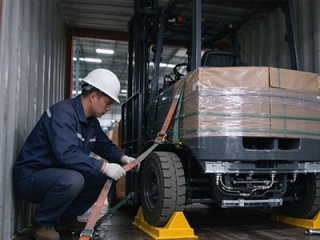 Full Container Supply For Export Forklifts, Forklift ManufacturerBulk forklift orders for overseas can ship by FCL or LCL. Newnewton FCL offers stable freight, safer packing and mixed models for large purchases.
Do you like ?0
Read more -
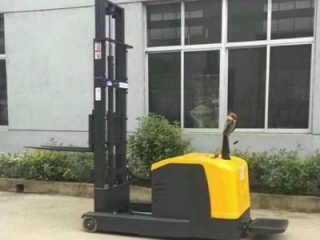 Stand-on Reach Stacker For Narrow Aisle Stacking, Mast Reach StructureStand-on reach stackers feature sliding masts that stay outside racks. They boost storage density in narrow aisles and require flat floors and standard pallets.
Do you like ?0
Read more -
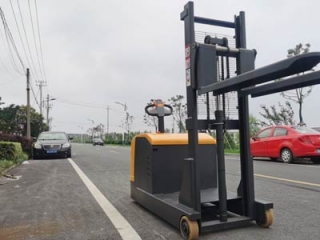 Stand-on Counterbalance Stacker For Various Pallets, Why No Leg RestrictionCounterbalance stackers have no front outriggers, using rear counterweight to avoid pallet interference. They fit various odd pallets yet need wider warehouse aisles.
Do you like ?0
Read more -
 Custom Walk-Behind Counterbalance Stacker | Non-Standard ModificationsStandard walk-behind counterbalance stackers struggle with non-standard pallets and tight aisles. Customize load, lift, forks and structure, share working conditions for safe design.
Do you like ?0
Read more