Narrow Aisle Forklift vs Ordinary Forklift, Core Comparison Points
Before purchasing forklifts, buyers need to learn the differences between various forklift types and master basic knowledge of forklift selection. Sufficient preparation can avoid wrong model selection which delays project schedules. This article compares narrow aisle forklifts and ordinary forklifts to clarify how to distinguish narrow aisle forklift from ordinary forklift.
Minimum working aisle width
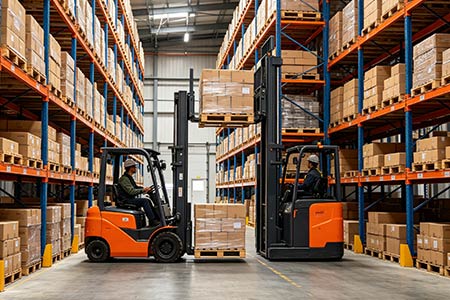
Standard counterbalanced forklifts turn the whole vehicle and require wider aisles. For 3-ton internal combustion or electric counterbalanced forklifts, the working aisle width is generally over 3.5 meters. Narrow aisle forklifts include reach trucks and three-way stacking forklifts. Their minimum working aisle can be reduced to 1.8 to 2.8 meters, greatly improving the storage density of warehouse racks.
Vehicle structure design
Ordinary forklifts are equipped with rear counterweights to offset the moment of cargo. They have longer body and large turning radius. Most narrow aisle forklifts adopt reach mast or three-way fork structure. They do not need large-scale body turning. Stacking is realized through mast forward movement or fork rotation. The whole machine has a shorter body without requiring wide turning space.
Stacking operation mode
Ordinary forklifts need to turn the whole vehicle to align forks with pallets, and the vehicle position changes greatly during loading and unloading. Narrow aisle forklifts keep the body moving straight basically. Pallet picking and placing are completed in place through mast expansion and contraction or left-right rotation of forks. They deliver better stability for high-level stacking and suit high rack operations.
Applicable warehouse scenarios
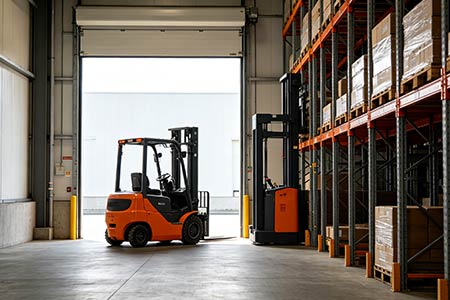
Ordinary forklifts are suitable for sites with wide aisles, mixed cargo types and outdoor transfer. They handle both short-distance transportation and stacking tasks. Narrow aisle forklifts are designed for indoor high-rise stereoscopic warehouses and mainly complete rack access. They are less efficient for long-distance transfer and not fit for uneven outdoor ground.
To judge how to distinguish narrow aisle forklift from ordinary forklift, calculate the available aisle width and rack height of the warehouse first. Choose ordinary forklifts if aisles are spacious and outdoor transfer is required. Pick narrow aisle forklifts to increase storage capacity and store goods densely on high racks. Feel free to contact us if you have any questions about these two types of forklifts.
-
 Reliability Of Newnewton Warehouse Forklifts For Heavy-Duty ShiftsWarehouse forklift reliability relies on industrial parts, reinforced frames and factory durability tests. Proper operation and maintenance reduce unexpected downtime.
Do you like ?0
Read more -
 Forklift Configuration Strategy For Dense Warehousing, Warehouse ForkliftDense warehousing needs matched forklifts besides racks. Reach and trilateral stackers fit different layouts, coordinate aisle, load curve and floor for smooth handling.
Do you like ?0
Read more -
 Full Container Supply For Export Forklifts, Forklift ManufacturerBulk forklift orders for overseas can ship by FCL or LCL. Newnewton FCL offers stable freight, safer packing and mixed models for large purchases.
Do you like ?0
Read more -
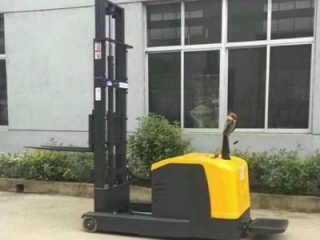 Stand-on Reach Stacker For Narrow Aisle Stacking, Mast Reach StructureStand-on reach stackers feature sliding masts that stay outside racks. They boost storage density in narrow aisles and require flat floors and standard pallets.
Do you like ?0
Read more -
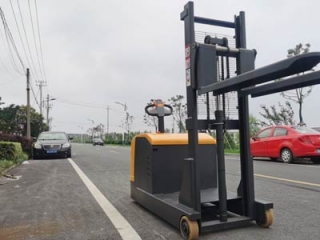 Stand-on Counterbalance Stacker For Various Pallets, Why No Leg RestrictionCounterbalance stackers have no front outriggers, using rear counterweight to avoid pallet interference. They fit various odd pallets yet need wider warehouse aisles.
Do you like ?0
Read more -
 Custom Walk-Behind Counterbalance Stacker | Non-Standard ModificationsStandard walk-behind counterbalance stackers struggle with non-standard pallets and tight aisles. Customize load, lift, forks and structure, share working conditions for safe design.
Do you like ?0
Read more