
Stand-on Reach Stacker vs Sit-down Reach Forklift, How to Choose
Many warehouse operators hesitate when selecting reach-type forklifts for warehouse upgrading. Both stand-on reach stacker forklift and sit-down reach forklift adopt the extending mast for high stacking, yet they fit different warehouse conditions and operation rhythms. Below are the differences between stand-on reach stacker and sit-down reach forklift.
In terms of aisle requirements, the stand-on reach stacker has a more compact body and smaller turning radius. It needs narrower aisles and fits dense rack warehouses with limited space. The sit-down reach forklift comes with a cabin and longer wheelbase. It requires wider passage space and is less flexible when maneuvering in narrow aisles.
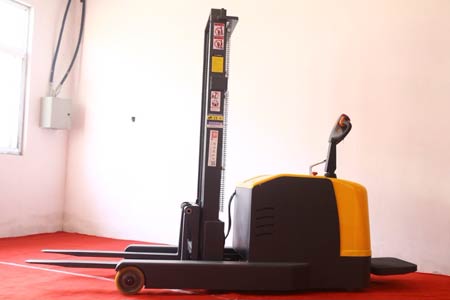
They differ in operation experience and work intensity. Operators stand to control the stand-on model, making it easy to get on and off. It delivers higher efficiency for frequent short-distance picking and multi-point transfer, but operators get fatigued more easily during nonstop long shifts. The sit-down version has a seat, which suits long-distance transport and continuous operation. It reduces physical exhaustion and works better for long rotating shifts.
There are also gaps in load capacity and lifting height. Stand-on reach stackers are mainly designed for light and medium loads and can meet the lifting demands of regular high racks. Sit-down reach forklifts have a higher load limit and more mast options, ideal for heavy goods and ultra-high rack stacking tasks.
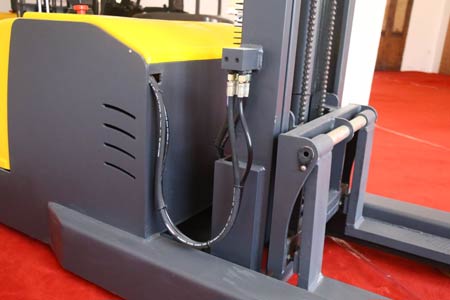
They are not the same in purchase cost and later maintenance. The stand-on reach stacker features a simpler structure with lower purchase price and affordable spare parts, and maintenance is easier. The sit-down reach forklift has richer configurations and a higher overall cost. It contains more components, so its long-term maintenance expense is relatively higher.
Neither type is absolutely superior. Your choice depends on aisle width, cargo tonnage and daily operation hours. newnewton Stand-on reach stacker forklift can be equipped with matched masts and load schemes according to your rack layout.
-
 Full Product Range of Newnewton Forklift for Warehouse Handling SolutionsNewnewton forklifts cover five series for transport, stacking and offloading. Customization and export services are available for diverse warehouse applications.
Do you like ?0
Read more -
 Precautions for Forklift Operation in Narrow WarehousesNarrow dense racks leave little margin for forklifts. Six rules including aisle check, speed control and pre-shift inspection balance safety and handling efficiency.
Do you like ?0
Read more -
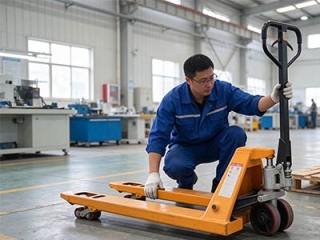 How Is Warehouse Manual Pallet Truck? Key Selection Tips for ExportOverseas bulk manual pallet truck purchases need CE compliance and local pallet standards for SE Asia, Europe and America to cut return risks.
Do you like ?0
Read more -
 How Much Does an Electric Self-Elevating Stacker CostPrices of electric self-loading stackers vary widely. Check load, lift, battery and controls, plus certificates and after-sales to avoid overpricing traps.
Do you like ?0
Read more -
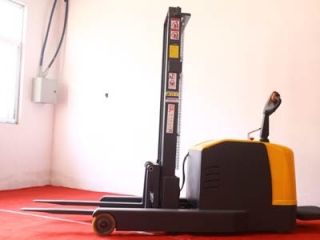 Stand-on Reach Stacker vs Sit-down Reach Forklift, How to ChooseRide-on and stand-on reach stackers both use extendable masts, yet differ in aisle demand, workload, lifting capacity and service cost.
Do you like ?0
Read more -
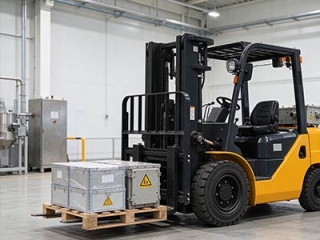 GB 19854 & GB 3836 Guide for Explosion-proof Electric Forklift SelectionWhen buying newnewton explosion-proof forklifts, follow GB 19854 & GB 3836, verify full certificates and distinguish original units from retrofitted ones.
Do you like ?0
Read more








