
Large Sit‑Down Reach Stacker | Buying Guide for High‑Rack Warehouse
Many enterprises hope to expand storage capacity by installing higher racks, yet they are limited by ordinary forklifts. Counterbalance forklifts demand wide working aisles, while small reach stackers lack sufficient stability under high‑lift conditions. As a result, the sit‑down reach stacker has become mainstream equipment for high‑density warehouse upgrading. Many purchasers fail to tell the difference between large and small reach stackers. Blindly selecting according to nominal parameters will lead to unsatisfactory storage capacity and working efficiency.
Large Reach Stacker VS Small Reach Stacker
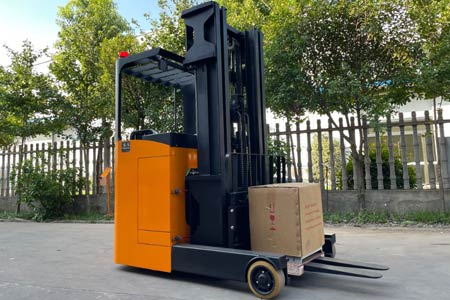
The large electric reach stacker adopts sit‑down operation with heavier dead weight and adequate chassis counterweight. Its full‑mast reach design enables lifting height up to 8‑10 m and retains better residual load capacity at high positions. Most small reach stackers are stand‑on lightweight units, suitable for stacking below 6 m. Their stability declines sharply as lifting height increases. Though both own extendable masts, they differ greatly in chassis structure and continuous‑operation performance and cannot substitute for one another.
Suitable Application Scenarios
Sit‑down large reach stackers fit e‑commerce stereoscopic warehouses, parts‑manufacturing workshops and integrated raw‑material‑finished‑goods warehouses. For rack height ranging from 6 m to 10 m, working aisle can be compressed to 2.2‑2.6 m, lifting warehouse space utilization by around 30 % compared with traditional counterbalance forklifts.
Sit‑down mode lowers driver fatigue for multi‑shift heavy‑duty work in high‑throughput warehouses. Equipped with low‑temperature modification kits, it can also serve cold‑storage high‑density rack systems.
Pay Attention to High‑lift Load Derating
Do not depend merely on name‑plate rated load. Actual bearing capacity drops obviously at high lifting positions. Load derating occurs when lifting up to 8 m. Buyers shall check load curve to confirm real effective load and reserve enough safety margin to prevent shaking and cargo falling. Triple‑stage mast is recommended for lifting over 6 m to improve mast rigidity and upper‑level visibility.
Warehouse Site Constraints
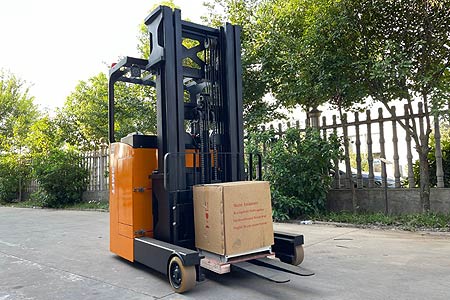
Measure actual aisle clear width and warehouse net height. Fire‑fighting pipelines and lighting bridges should be counted into total height clearance. Floors must be flat and hardened; uneven ground will aggravate mast shaking under high lift. Check overall machine dimension to guarantee smooth passage through doors and elevators.
Power Configuration Matching Work Intensity
Large‑capacity lithium battery is preferred for two‑shift heavy‑duty tasks, supporting opportunity charging and cutting downtime. Lead‑acid battery helps control procurement cost for single‑shift operation. Reliable hydraulic and electric‑control components together with buffer function for mast moving and lifting reduce collision risk to racks and goods for high‑level stacking.
High‑density warehouse renovation is more than simply raising rack height. Take rack height, measured aisle width and daily working shifts into consideration. Distinguish performance limits of large electric reach stacker and small reach stacker, and take real high‑lift effective load as core selection standard to balance storage capacity and handling efficiency.
-
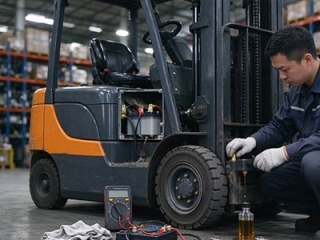 Reliability Of Newnewton Warehouse Forklifts For Heavy-Duty ShiftsWarehouse forklift reliability relies on industrial parts, reinforced frames and factory durability tests. Proper operation and maintenance reduce unexpected downtime.
Do you like ?0
Read more -
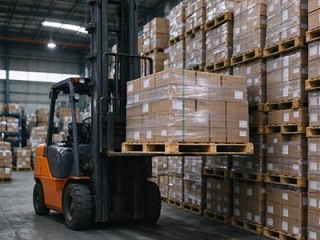 Forklift Configuration Strategy For Dense Warehousing, Warehouse ForkliftDense warehousing needs matched forklifts besides racks. Reach and trilateral stackers fit different layouts, coordinate aisle, load curve and floor for smooth handling.
Do you like ?0
Read more -
 Full Container Supply For Export Forklifts, Forklift ManufacturerBulk forklift orders for overseas can ship by FCL or LCL. Newnewton FCL offers stable freight, safer packing and mixed models for large purchases.
Do you like ?0
Read more -
 Stand-on Reach Stacker For Narrow Aisle Stacking, Mast Reach StructureStand-on reach stackers feature sliding masts that stay outside racks. They boost storage density in narrow aisles and require flat floors and standard pallets.
Do you like ?0
Read more -
 Stand-on Counterbalance Stacker For Various Pallets, Why No Leg RestrictionCounterbalance stackers have no front outriggers, using rear counterweight to avoid pallet interference. They fit various odd pallets yet need wider warehouse aisles.
Do you like ?0
Read more -
 Custom Walk-Behind Counterbalance Stacker | Non-Standard ModificationsStandard walk-behind counterbalance stackers struggle with non-standard pallets and tight aisles. Customize load, lift, forks and structure, share working conditions for safe design.
Do you like ?0
Read more








