
Many small warehouses wonder which is more cost-effective between semi-electric stacker and manual stacker when purchasing stacking equipment. If you only compare the upfront price, long-term operating costs are easily ignored. We carry out procurement calculation from three dimensions including initial investment, working efficiency and maintenance cost for clear reference.
For initial procurement cost, manual stacker features simple structure without batteries and motors, so it comes with a lower purchase price and less capital pressure. It suits warehouses with tight budget and low usage frequency. The semi-electric stacker lifts goods by electric power while moving by manual pushing and pulling. Equipped with battery and electric hydraulic system, semi-electric stacker has a higher price and needs larger one-time investment.
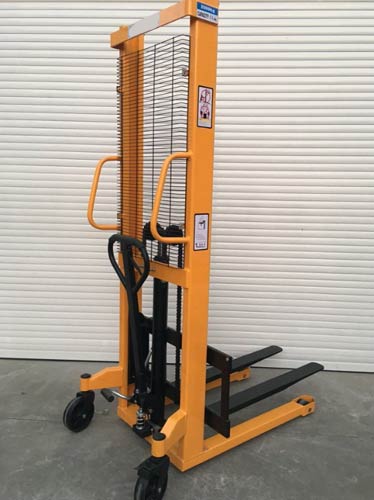
In terms of working efficiency and labor cost, manual stacker relies on manual pumping for full lifting operation. Heavier cargo brings harder lifting work. Operators suffer high labor intensity and slow stacking speed, so it is not fit for frequent stacking tasks. The semi-electric stacker uses motor for lifting, and workers only push and pull the truck manually. It saves time and labor in cargo stacking and reduces physical fatigue of operators. For warehouses with daily repeated stacking work, it cuts labor consumption in the long run.
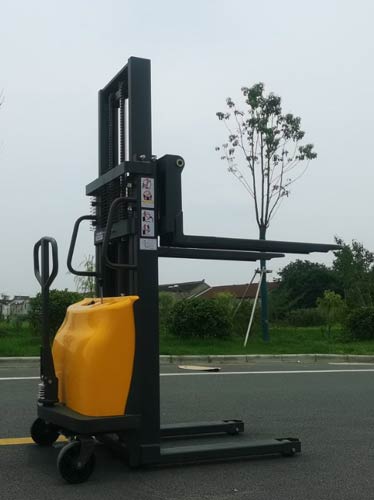
Regarding later maintenance cost, manual stacker has few components. Maintenance mainly focuses on hydraulic cylinders, sealing rings and wheel assemblies. It has fewer failure points with simple and cheap upkeep. Besides hydraulic parts, semi-electric stacker is fitted with storage battery, motor and electric control components. The battery is a consumable part which needs replacement after several years, and regular charging maintenance is required. It has more maintenance items than manual stacker.
Both manual stacker and semi-electric stacker price are affordable. You can select the proper forklift by referring to the above comparison. Feel free to contact us if you have any questions.
-
 Reliability Of Newnewton Warehouse Forklifts For Heavy-Duty ShiftsWarehouse forklift reliability relies on industrial parts, reinforced frames and factory durability tests. Proper operation and maintenance reduce unexpected downtime.
Do you like ?0
Read more -
 Forklift Configuration Strategy For Dense Warehousing, Warehouse ForkliftDense warehousing needs matched forklifts besides racks. Reach and trilateral stackers fit different layouts, coordinate aisle, load curve and floor for smooth handling.
Do you like ?0
Read more -
 Full Container Supply For Export Forklifts, Forklift ManufacturerBulk forklift orders for overseas can ship by FCL or LCL. Newnewton FCL offers stable freight, safer packing and mixed models for large purchases.
Do you like ?0
Read more -
 Stand-on Reach Stacker For Narrow Aisle Stacking, Mast Reach StructureStand-on reach stackers feature sliding masts that stay outside racks. They boost storage density in narrow aisles and require flat floors and standard pallets.
Do you like ?0
Read more -
 Stand-on Counterbalance Stacker For Various Pallets, Why No Leg RestrictionCounterbalance stackers have no front outriggers, using rear counterweight to avoid pallet interference. They fit various odd pallets yet need wider warehouse aisles.
Do you like ?0
Read more -
 Custom Walk-Behind Counterbalance Stacker | Non-Standard ModificationsStandard walk-behind counterbalance stackers struggle with non-standard pallets and tight aisles. Customize load, lift, forks and structure, share working conditions for safe design.
Do you like ?0
Read more








