Semi‑Electric Stacker: Standard Operating Steps for Warehouse Handling
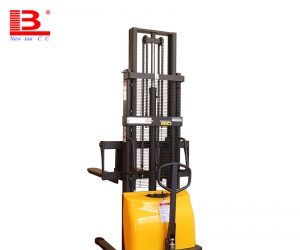
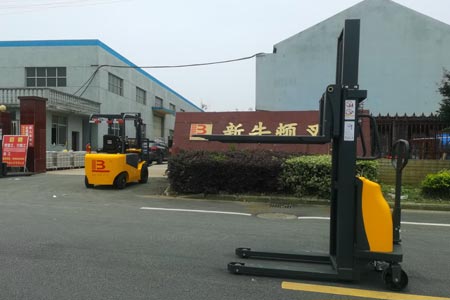
Learn the semi‑electric stacker operating steps before warehouse deployment, so operators can start work immediately after equipment arrival without delaying warehouse schedules. Improper operation may lead to cargo tipping, equipment damage and personal injury risks. Below is the standardized factory operating procedure for semi‑electric hydraulic stacker.
Pre‑operation Inspection
External structure: Check mast, forks and frame for deformation or cracks. Ensure chains are evenly tensioned without jamming; bolts and pins shall not be loose or missing. Hydraulic system: Verify oil cylinders and pipe joints have no oil leakage. Lifting motion shall be smooth with no stuck movement or abnormal noise. Battery & circuit: Confirm sufficient battery power. Connectors shall be tight and free of damage or exposed wires. Lifting buttons and switches shall respond sensitively. Travel & brake: Push the truck manually; wheels shall rotate freely without trapped debris. Braking system needs to be responsive and reliable. Working environment: Clear obstacles in aisles. Keep ground flat and dry, avoid oil stains and pooled water. Plan travel routes in advance for ramps.
Standard Operation Procedure
Picking up cargo Manually push the semi‑electric stacker slowly toward the pallet. Keep forks horizontal and aligned with pallet openings, then push forward until forks fully go under the pallet. Center the load. Avoid offset loading, single‑side fork engagement or partial fork suspension.
Electric load lifting After confirming forks are fully inserted and cargo is stable, press the up button to lift forks at constant speed. Do not perform sudden lifting or lowering. After lifting cargo off the ground, check for tilting before transportation.
Manual transporting Keep forks 10‑20 cm above ground during transport to lower the center of gravity. Push at low steady speed. No fast running, sudden stops or sharp turns. Slow down in narrow aisles to avoid collisions with personnel. Never overload the truck. Do not carry passengers. Keep people away from fork area during movement.
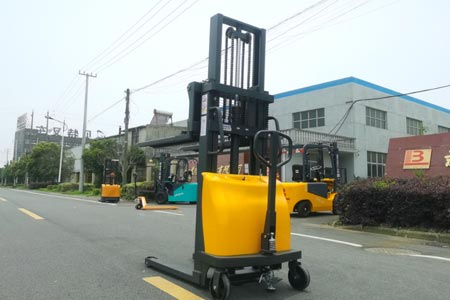
Stacking and unloading Push to the target stacking position and confirm no overhead obstacles. Lift forks smoothly to required height and align with rack position. Press down button to lower cargo steadily. After cargo is fully landed and forks are unloaded, back up and pull out forks to finish stacking. Do not force alignment at high height or drag loaded forks.
Post‑work shutdown When all tasks are finished, lower forks to the lowest position and power off the unit. Clean dirt and debris from forks and wheel gaps. Park in designated area, do not block main aisles or fire exits. Disconnect power for long‑term storage and recharge regularly to prevent battery damage from power loss.
This guideline serves for both equipment procurement and operator training for the semi‑electric hydraulic stacker, helping you put the forklift into service quickly.
-
 Reliability Of Newnewton Warehouse Forklifts For Heavy-Duty ShiftsWarehouse forklift reliability relies on industrial parts, reinforced frames and factory durability tests. Proper operation and maintenance reduce unexpected downtime.
Do you like ?0
Read more -
 Forklift Configuration Strategy For Dense Warehousing, Warehouse ForkliftDense warehousing needs matched forklifts besides racks. Reach and trilateral stackers fit different layouts, coordinate aisle, load curve and floor for smooth handling.
Do you like ?0
Read more -
 Full Container Supply For Export Forklifts, Forklift ManufacturerBulk forklift orders for overseas can ship by FCL or LCL. Newnewton FCL offers stable freight, safer packing and mixed models for large purchases.
Do you like ?0
Read more -
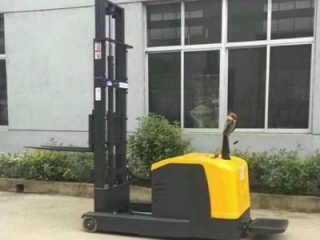 Stand-on Reach Stacker For Narrow Aisle Stacking, Mast Reach StructureStand-on reach stackers feature sliding masts that stay outside racks. They boost storage density in narrow aisles and require flat floors and standard pallets.
Do you like ?0
Read more -
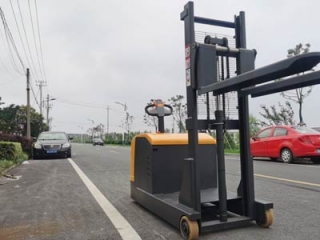 Stand-on Counterbalance Stacker For Various Pallets, Why No Leg RestrictionCounterbalance stackers have no front outriggers, using rear counterweight to avoid pallet interference. They fit various odd pallets yet need wider warehouse aisles.
Do you like ?0
Read more -
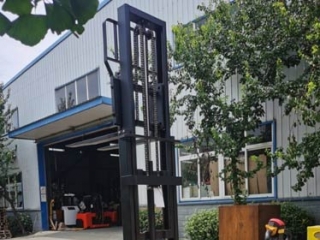 Custom Walk-Behind Counterbalance Stacker | Non-Standard ModificationsStandard walk-behind counterbalance stackers struggle with non-standard pallets and tight aisles. Customize load, lift, forks and structure, share working conditions for safe design.
Do you like ?0
Read more