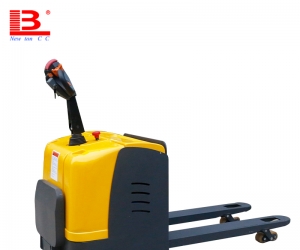
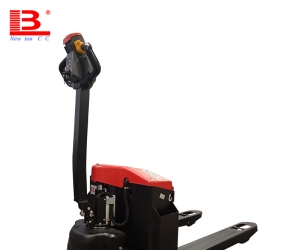
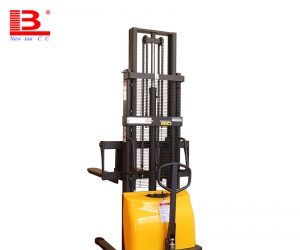
Many enterprises are confused about which material‑handling trucks allow operation without license. A frequent question is whether an operator needs a forklift license for stand‑on electric stacker. Widely adopted by small‑and‑medium‑sized enterprises, confirming N1 operator certificate requirement is critical for site management.
Four conditions define special‑purpose factory vehicles under current safety regulations. Equipment is classified as special‑equipment forklift and requires N1 operator certificate when all four items are met: man‑ridden stand‑on operation, rigid lifting mast, forks equipped and self‑propelled driving power. Fully‑electric stand‑on electric stacker satisfies all four criteria. When operated inside factories and warehouses, it falls under regulated industrial vehicle scope.
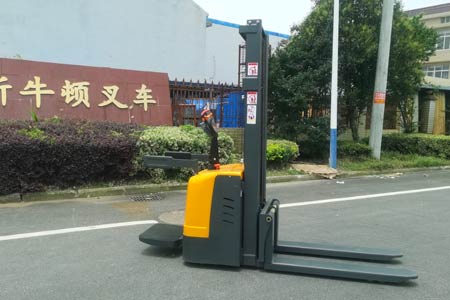
Distinguish stand‑on stacker from non‑certificate‑required models. Semi‑electric walk‑behind stackers feature electric lifting while movement relies on manual pushing. They are not categorized as special‑equipment vehicles and do not force N1 certification. By contrast, stand‑on models are self‑propelled with drive motors. Even for 1‑ton units, they belong to special‑equipment management, requiring equipment registration, periodic inspection and licensed operators. Many companies hold the common misconception that compact size means no license is needed.
Typical compliance pitfalls for enterprises: Some firms only deliver equipment training without arranging official certification, which brings administrative penalties during safety inspections. Ordinary road driving licenses cannot replace N1 industrial vehicle certificates, since they belong to separate qualification systems. For equipment rental services, not only trucks shall comply with rules, but on‑site operators must hold valid N1 certificates.
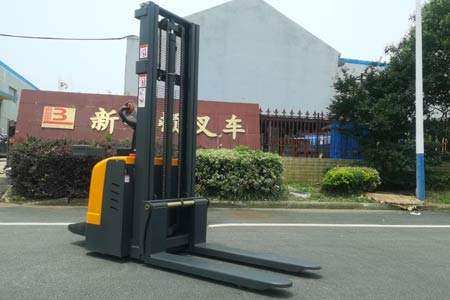
Practical advice for procurement and daily management. When purchasing stand‑on loading stacker, select manufacturers with special‑equipment production qualification and request factory certificates and type‑test reports. Complete equipment registration within 30 days after commissioning and arrange periodic annual inspection. Personnel without valid certificates are forbidden for independent operation. They may only observe and study under supervision of licensed staff instead of performing stacking tasks alone. Pre‑job safety training covering speed limit, load capacity and mast operation rules shall be conducted to prevent cargo tip‑over risks.
Do not judge license requirement merely by equipment dimension. Refer to the four special‑equipment judging criteria, confirm vehicle classification, enforce licensed operators and equipment inspection, so as to avoid production interruptions caused by non‑compliance.
-
 Reliability Of Newnewton Warehouse Forklifts For Heavy-Duty ShiftsWarehouse forklift reliability relies on industrial parts, reinforced frames and factory durability tests. Proper operation and maintenance reduce unexpected downtime.
Do you like ?0
Read more -
 Forklift Configuration Strategy For Dense Warehousing, Warehouse ForkliftDense warehousing needs matched forklifts besides racks. Reach and trilateral stackers fit different layouts, coordinate aisle, load curve and floor for smooth handling.
Do you like ?0
Read more -
 Full Container Supply For Export Forklifts, Forklift ManufacturerBulk forklift orders for overseas can ship by FCL or LCL. Newnewton FCL offers stable freight, safer packing and mixed models for large purchases.
Do you like ?0
Read more -
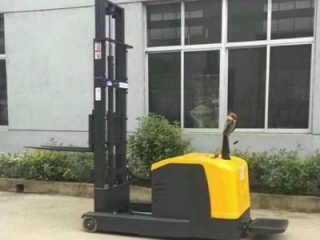 Stand-on Reach Stacker For Narrow Aisle Stacking, Mast Reach StructureStand-on reach stackers feature sliding masts that stay outside racks. They boost storage density in narrow aisles and require flat floors and standard pallets.
Do you like ?0
Read more -
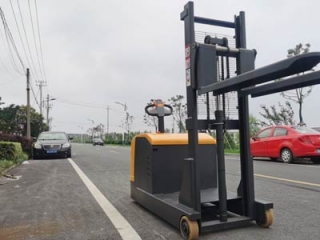 Stand-on Counterbalance Stacker For Various Pallets, Why No Leg RestrictionCounterbalance stackers have no front outriggers, using rear counterweight to avoid pallet interference. They fit various odd pallets yet need wider warehouse aisles.
Do you like ?0
Read more -
 Custom Walk-Behind Counterbalance Stacker | Non-Standard ModificationsStandard walk-behind counterbalance stackers struggle with non-standard pallets and tight aisles. Customize load, lift, forks and structure, share working conditions for safe design.
Do you like ?0
Read more