
Walk-behind Counterbalance Stacker Short Runtime | Battery Maintenance Solutions
Does your Walk-behind Counterbalance Stacker suffer from short runtime, reduced working efficiency, fake full charge, and fail to support frequent cargo handling? Do not rush to replace your equipment or batteries. First identify root causes to avoid repeated failures and extra expenditure.
Main Causes Of Short Battery Runtime
Poor charging habits accelerate cell degradation Deep discharge: frequently drain power until the stacker shuts down automatically. Continuous floating charge: leave charger connected long after fully charged. Mismatched low-quality non-original chargers cause unstable voltage and permanent battery damage.
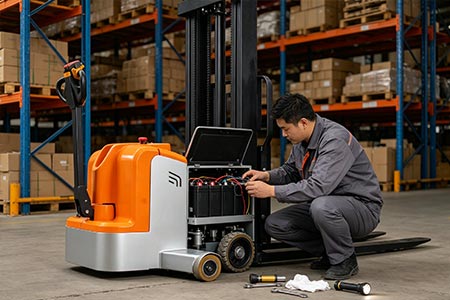
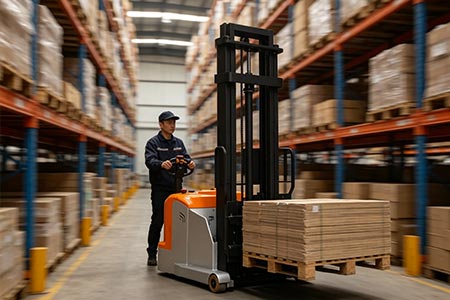
Continuous high-current heavy-load operation Counterbalance stackers often transport heavy goods. Repeated full-load lifting, abrupt start-stop and long-distance climbing trigger instantaneous high battery current, raising temperature and speeding up capacity attenuation.
Ambient temperature suppresses battery activity High-temperature warehouses in summer and cold uninsulated storage areas reduce effective battery capacity. Poor ventilation in enclosed warehouses leads to poor heat dissipation during continuous operation, resulting in obvious runtime drop.
Lack of regular inspections; hidden faults increase power consumption Stuck wheels, dragging brakes, excessive hydraulic resistance or minor circuit leakage force the motor to draw higher current. Oxidized & loose battery terminals lead to unstable power supply and insufficient output power.
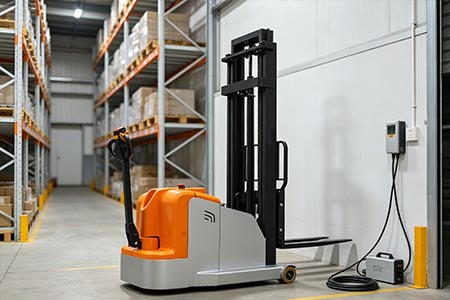
Battery reaches end of cycle service life Lead-acid batteries: roughly 300–500 charge-discharge cycles. Lithium iron phosphate batteries: 500–1200 cycles. When reaching designed lifespan, cells suffer irreversible aging. Maintenance alone cannot recover runtime; battery replacement becomes necessary.
Targeted Maintenance Solutions
For Lithium Iron Phosphate Battery Models
Recharge promptly when remaining power hits 20%–30%; avoid complete discharge.
Keep ventilation during charging. Pause charging if battery overheats and resume after natural cooling.
Maintain charge level at 40%–60% during long idle periods; top up power every 30 days.
Never rinse battery enclosure with high-pressure water to prevent terminal moisture and oxidation.
For Maintenance-free Lead-acid Battery Models
Avoid long-term storage under low charge. Supplement power if idle longer than 15 days.
Ensure warehouse ventilation while charging to eliminate hydrogen accumulation hazards.
Monitor voltage of individual battery units; perform balancing repair when voltage difference becomes excessive.
Prevent battery casing collision damage and electrolyte leakage.
This guide helps warehouse operators master battery maintenance for the Walk-behind Counterbalance Stacker and lower battery failure frequency.
-
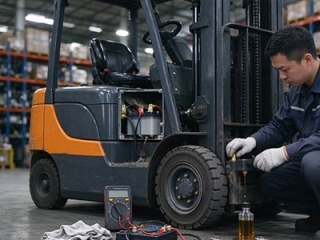 Reliability Of Newnewton Warehouse Forklifts For Heavy-Duty ShiftsWarehouse forklift reliability relies on industrial parts, reinforced frames and factory durability tests. Proper operation and maintenance reduce unexpected downtime.
Do you like ?0
Read more -
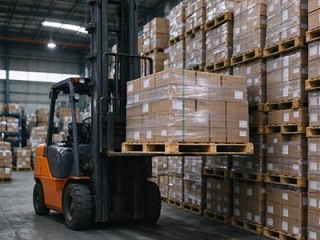 Forklift Configuration Strategy For Dense Warehousing, Warehouse ForkliftDense warehousing needs matched forklifts besides racks. Reach and trilateral stackers fit different layouts, coordinate aisle, load curve and floor for smooth handling.
Do you like ?0
Read more -
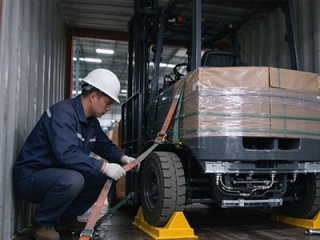 Full Container Supply For Export Forklifts, Forklift ManufacturerBulk forklift orders for overseas can ship by FCL or LCL. Newnewton FCL offers stable freight, safer packing and mixed models for large purchases.
Do you like ?0
Read more -
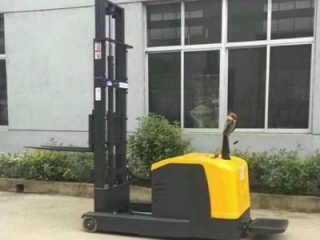 Stand-on Reach Stacker For Narrow Aisle Stacking, Mast Reach StructureStand-on reach stackers feature sliding masts that stay outside racks. They boost storage density in narrow aisles and require flat floors and standard pallets.
Do you like ?0
Read more -
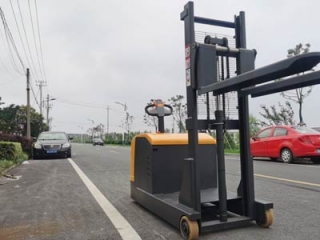 Stand-on Counterbalance Stacker For Various Pallets, Why No Leg RestrictionCounterbalance stackers have no front outriggers, using rear counterweight to avoid pallet interference. They fit various odd pallets yet need wider warehouse aisles.
Do you like ?0
Read more -
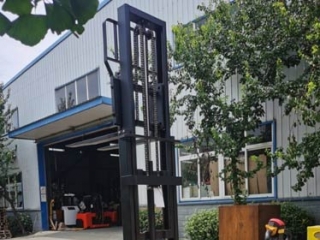 Custom Walk-Behind Counterbalance Stacker | Non-Standard ModificationsStandard walk-behind counterbalance stackers struggle with non-standard pallets and tight aisles. Customize load, lift, forks and structure, share working conditions for safe design.
Do you like ?0
Read more








