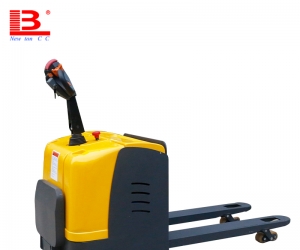
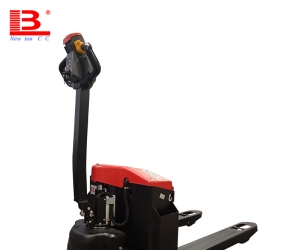
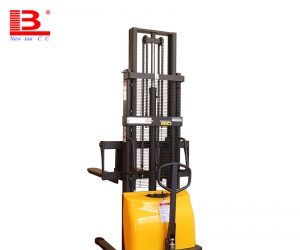
Walkie VS Stand-on Counterbalance Stacker for Warehouse High Stacking
For warehouses with dense racks and high stacking, legless counterbalance stackers can solve most stacking problems. Many buyers wonder about the differences between walkie counterbalance stacker and stand-on counterbalance stacker. Wrong selection will affect warehouse turnover efficiency greatly. The two types differ obviously in operation mode and working efficiency.
Operation mode For walkie counterbalance stacker, the operator controls the machine while walking beside it. Travel and lifting are controlled by the handle, with flexible steering and stable low-speed operation. For stand-on counterbalance stacker, the operator stands on the platform of the vehicle. Operate the control handles with both hands for more stable operation experience.
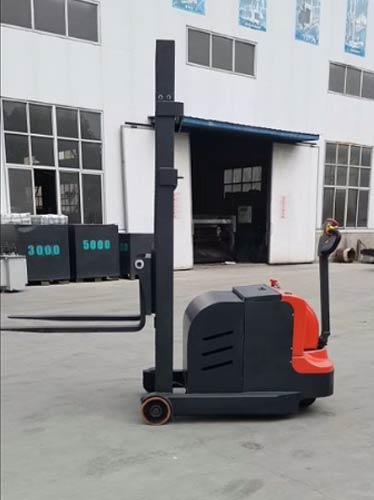
Working efficiency Walkie models work well for short-distance and intermittent stacking tasks. It features flexible start and stop. Stand-on stackers show great advantages in long-distance continuous high stacking. Higher moving speed cuts physical consumption and suits continuous high-frequency operations.
Working aisle requirement Walkie stacker has a more compact body and smaller minimum working aisle. It is easier to pass through narrow-space warehouses. The stand-on type comes with an operation platform and wider overall width. It requires wider warehouse aisles. On-site aisle measurement is necessary before selection.
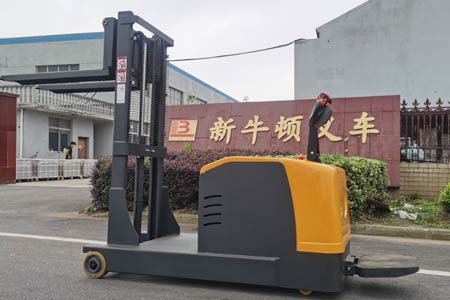
Load and lifting performance With the same rated tonnage, the maximum lifting height of the two models is close. Both can stack single-sided pallets. The stand-on stacker has larger margin in counterweight design. It delivers better stability during high-level lifting and frequent high stacking. Walkie stacker is suitable for intermittent medium-low height, light and medium load work.
Purchase and operation cost Walkie counterbalance stacker has lower purchase price and simple structure. Its later maintenance cost is low. Stand-on stacker is equipped with more components, leading to higher procurement cost. With more electrical parts, its maintenance is more complicated.
In summary, choose walkie counterbalance stacker for intermittent work, narrow aisles and limited budget. Select legless stand-on stacker for continuous high-frequency stacking, high efficiency demand and frequent high-level stacking.
-
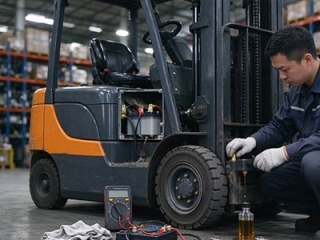 Reliability Of Newnewton Warehouse Forklifts For Heavy-Duty ShiftsWarehouse forklift reliability relies on industrial parts, reinforced frames and factory durability tests. Proper operation and maintenance reduce unexpected downtime.
Do you like ?0
Read more -
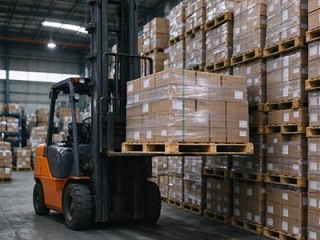 Forklift Configuration Strategy For Dense Warehousing, Warehouse ForkliftDense warehousing needs matched forklifts besides racks. Reach and trilateral stackers fit different layouts, coordinate aisle, load curve and floor for smooth handling.
Do you like ?0
Read more -
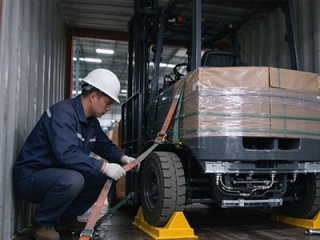 Full Container Supply For Export Forklifts, Forklift ManufacturerBulk forklift orders for overseas can ship by FCL or LCL. Newnewton FCL offers stable freight, safer packing and mixed models for large purchases.
Do you like ?0
Read more -
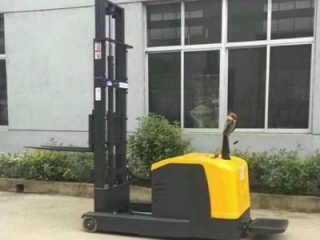 Stand-on Reach Stacker For Narrow Aisle Stacking, Mast Reach StructureStand-on reach stackers feature sliding masts that stay outside racks. They boost storage density in narrow aisles and require flat floors and standard pallets.
Do you like ?0
Read more -
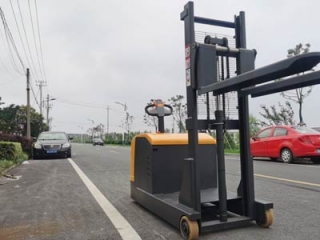 Stand-on Counterbalance Stacker For Various Pallets, Why No Leg RestrictionCounterbalance stackers have no front outriggers, using rear counterweight to avoid pallet interference. They fit various odd pallets yet need wider warehouse aisles.
Do you like ?0
Read more -
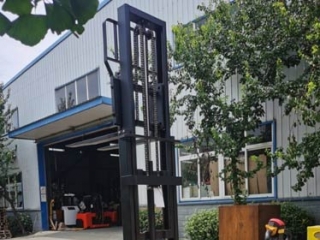 Custom Walk-Behind Counterbalance Stacker | Non-Standard ModificationsStandard walk-behind counterbalance stackers struggle with non-standard pallets and tight aisles. Customize load, lift, forks and structure, share working conditions for safe design.
Do you like ?0
Read more