
How often should you service a walk‑behind straddle stacker? Poor regular maintenance will raise failure rates and shorten service life of your warehouse equipment. Many companies only repair forklifts after breakdowns, which is far less cost‑effective than scheduled preventive service. Based on industry maintenance standards and guidance released by China Industrial Vehicle Network, here is the complete periodic maintenance schedule for the full‑electric straddle stacker.
Three working‑condition categories are defined by daily operating hours: light‑duty (under 2 hours per day), medium‑duty (2‑4 hours per day), heavy‑duty (4‑8 hours per day, multi‑shift operation). Maintenance tasks cover pre‑shift daily inspection, weekly service, monthly service and quarterly in‑depth overhaul.
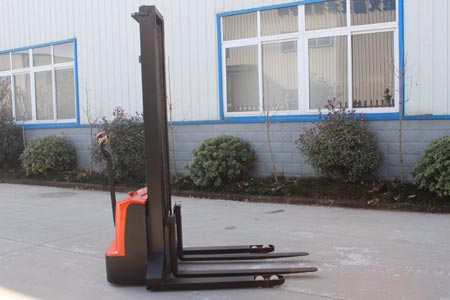
Daily pre‑shift inspection (mandatory for all usage profiles) Regardless of usage frequency, spend 5‑10 minutes on quick inspection before startup. Check battery level and avoid deep‑discharge operation; verify loose or over‑heated battery terminals. Test lifting, travelling and braking functions for abnormal noise or jamming. Inspect forks and chains for deformation or cracks; check straddle legs for collision damage. Look for oil leakage around the unit; confirm emergency stop button and horn work properly.
Weekly maintenance ‑ Light‑duty: Every two weeks ‑ Medium‑duty: Once per week ‑ Heavy‑duty: One‑two times per week
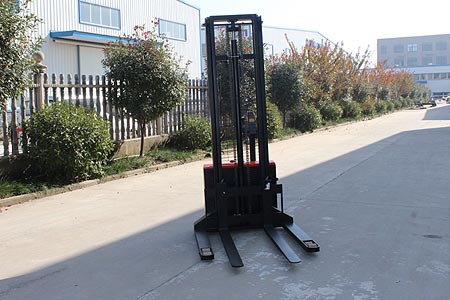
Clean dust and debris trapped inside chassis, mast and straddle leg gaps. Apply grease to mast guide rollers and chains to reduce friction‑caused wear. Inspect drive and load wheels for cracks and excessive wear. Check hydraulic hose connections for oil seepage; verify electrolyte level for lead‑acid batteries.
Monthly maintenance ‑ Light‑duty: Every two months ‑ Medium‑duty: Once per month ‑ Heavy‑duty: Once per month
Tighten bolts across the whole machine, focusing on straddle‑leg fasteners and mast connection bolts. Carry out deep hydraulic system inspection: check cylinder external leakage and confirm proper hydraulic oil level. Inspect controller wiring and connectors; remove dust and detect wire aging or abrasion. Verify overload protection and limit‑stop safety functions. Examine wear on straddle‑leg guide sliders; replace worn parts when excessive clearance causes mast shaking during lifting.
Quarterly in‑depth overhaul ‑ Light‑duty: Every six months ‑ Medium‑duty: Every 3‑4 months ‑ Heavy‑duty: Every three months
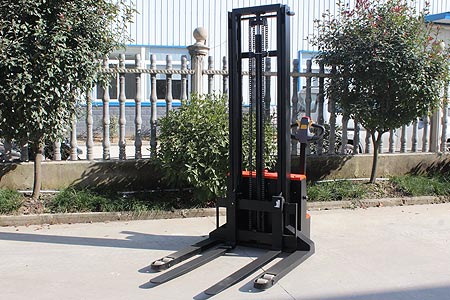
Test hydraulic oil quality; replace oil once it turns dark or contaminated with impurities. Complete battery health check: monitor cell status for lithium‑ion batteries; perform equalizing charge for lead‑acid batteries. Inspect brake assemblies and adjust brake pad clearance to guarantee reliable stopping performance. Visual weld‑joint inspection for mast and straddle legs to detect hidden cracks caused by impacts. Run full‑load functional tests: verify lifting and travelling performance under no‑load, half‑load and full‑load conditions.
Routine upkeep for the full‑electric straddle stacker is not complicated. Following this maintenance schedule helps cut long‑term repair costs and extend equipment service life, bringing tangible cost‑saving benefits for warehouses. Share your equipment load capacity and daily working hours, and we can deliver customized maintenance checklists as well as equipment selection advice.
-
 Reliability Of Newnewton Warehouse Forklifts For Heavy-Duty ShiftsWarehouse forklift reliability relies on industrial parts, reinforced frames and factory durability tests. Proper operation and maintenance reduce unexpected downtime.
Do you like ?0
Read more -
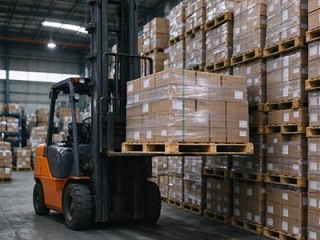 Forklift Configuration Strategy For Dense Warehousing, Warehouse ForkliftDense warehousing needs matched forklifts besides racks. Reach and trilateral stackers fit different layouts, coordinate aisle, load curve and floor for smooth handling.
Do you like ?0
Read more -
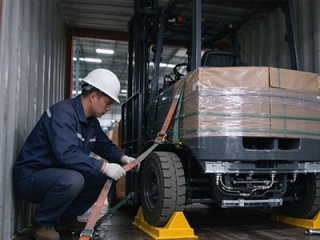 Full Container Supply For Export Forklifts, Forklift ManufacturerBulk forklift orders for overseas can ship by FCL or LCL. Newnewton FCL offers stable freight, safer packing and mixed models for large purchases.
Do you like ?0
Read more -
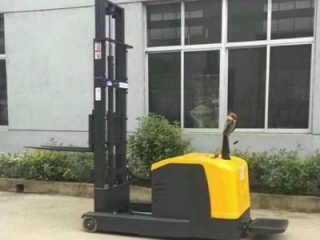 Stand-on Reach Stacker For Narrow Aisle Stacking, Mast Reach StructureStand-on reach stackers feature sliding masts that stay outside racks. They boost storage density in narrow aisles and require flat floors and standard pallets.
Do you like ?0
Read more -
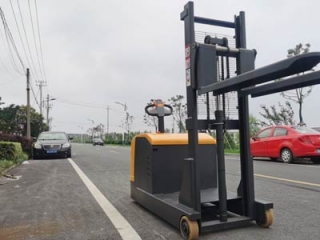 Stand-on Counterbalance Stacker For Various Pallets, Why No Leg RestrictionCounterbalance stackers have no front outriggers, using rear counterweight to avoid pallet interference. They fit various odd pallets yet need wider warehouse aisles.
Do you like ?0
Read more -
 Custom Walk-Behind Counterbalance Stacker | Non-Standard ModificationsStandard walk-behind counterbalance stackers struggle with non-standard pallets and tight aisles. Customize load, lift, forks and structure, share working conditions for safe design.
Do you like ?0
Read more








