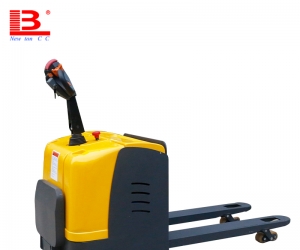
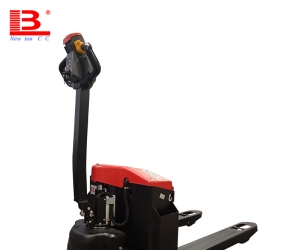
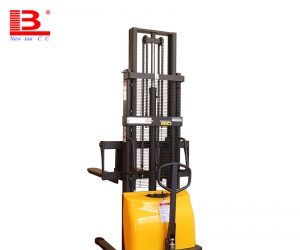
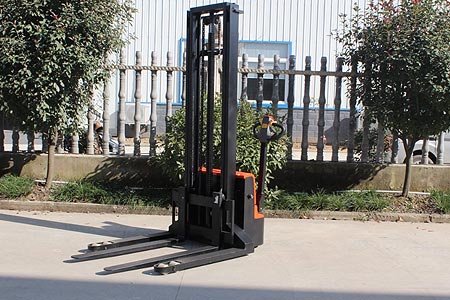
For small and medium-sized warehouses, load capacity and cost vary greatly between 1.5t and 2t straddle stacker models. Many buyers make selection mistakes by only referring to static cargo weight, because the walkie straddle electric stacker has obvious load attenuation characteristics. The rated load is different from the actual working load at high lifting height, which is the core factor when choosing 1.5t vs 2t straddle stacker.
1.5 Ton Straddle Stacker Load Performance
Rated load on flat ground: 1500kg
Effective load at 3m lifting height: 900–1100kg
Effective load at 3.5m lifting height: 700–850kg
2 Ton Straddle Stacker Load Performance
Rated load on flat ground: 2000kg
Effective load at 3m lifting height: 1300–1500kg
Effective load at 3.5m lifting height: 1000–1200kg
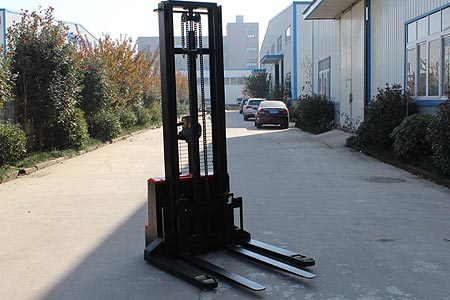
For frequent high stacking over 3 meters, even with an average cargo weight of 1.2 tons, the 1.5t straddle stacker will face insufficient load capacity. The 2t model is always the safer choice for high-level warehouse operations.
Body Dimension & Aisle Requirement
Under the same mast height, both walkie straddle electric stacker models have similar aisle adaptability, requiring a minimum working aisle of 2.3–2.6m. The 2t version adopts thicker steel for frames, outriggers and masts, with heavier overall weight and slightly higher steering inertia.
Power Consumption & Working Performance
The 2t straddle stacker is fitted with larger drive motors and hydraulic units. No obvious power gap exists under no-load conditions, but continuous full-load operation increases its energy consumption by 12%-18% compared with the 1.5t model. For long-term light-load and low-lift tasks, the 1.5t equipment offers better energy-saving performance.
Procurement & Maintenance Cost Analysis
Although the 2t walkie straddle electric stacker has a higher purchase price, it features stronger structural redundancy under heavy-duty conditions. Its hydraulic cylinders, wheel sets and load-bearing parts wear slower. In contrast, the 1.5t model suffers faster component aging if frequently operated under near-limit load.
The correct selection of straddle stacker should depend on lifting height, continuous load weight and operation frequency, rather than only static cargo weight. The 1.5t model delivers higher cost performance for low-lift and light-load scenarios, while the 2t model provides stable load margin and longer service life for high-level, heavy-load and high-frequency warehouse stacking.
Contact us for professional equipment selection and customized warehouse handling solutions.
-
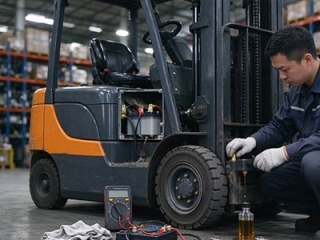 Reliability Of Newnewton Warehouse Forklifts For Heavy-Duty ShiftsWarehouse forklift reliability relies on industrial parts, reinforced frames and factory durability tests. Proper operation and maintenance reduce unexpected downtime.
Do you like ?0
Read more -
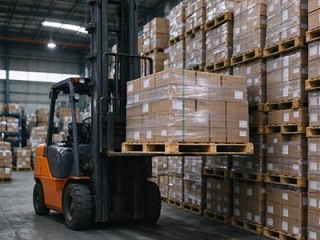 Forklift Configuration Strategy For Dense Warehousing, Warehouse ForkliftDense warehousing needs matched forklifts besides racks. Reach and trilateral stackers fit different layouts, coordinate aisle, load curve and floor for smooth handling.
Do you like ?0
Read more -
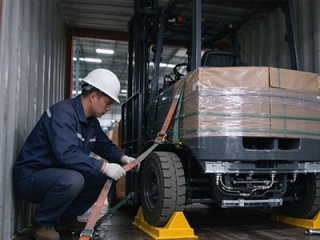 Full Container Supply For Export Forklifts, Forklift ManufacturerBulk forklift orders for overseas can ship by FCL or LCL. Newnewton FCL offers stable freight, safer packing and mixed models for large purchases.
Do you like ?0
Read more -
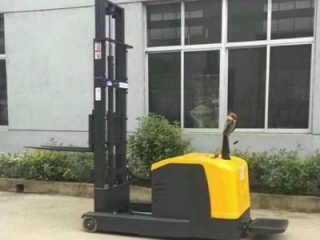 Stand-on Reach Stacker For Narrow Aisle Stacking, Mast Reach StructureStand-on reach stackers feature sliding masts that stay outside racks. They boost storage density in narrow aisles and require flat floors and standard pallets.
Do you like ?0
Read more -
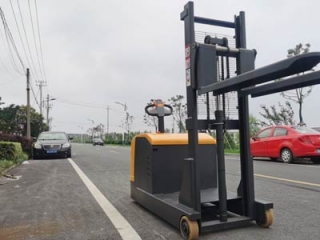 Stand-on Counterbalance Stacker For Various Pallets, Why No Leg RestrictionCounterbalance stackers have no front outriggers, using rear counterweight to avoid pallet interference. They fit various odd pallets yet need wider warehouse aisles.
Do you like ?0
Read more -
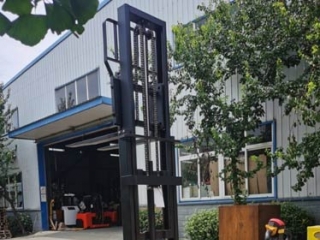 Custom Walk-Behind Counterbalance Stacker | Non-Standard ModificationsStandard walk-behind counterbalance stackers struggle with non-standard pallets and tight aisles. Customize load, lift, forks and structure, share working conditions for safe design.
Do you like ?0
Read more