
Counterbalance stackers have no outrigger restrictions and can handle thick-bottom pallets and special-shaped fixtures. Many buyers struggle to choose between walk-behind and stand-on versions. They share similar basic stacking capacity, yet differ greatly in operation intensity, aisle requirements and operating experience, matching different warehouse workflows. Here is the walk-behind vs stand-on counterbalance stacker comparison.
With a walk-behind counterbalance stacker, operators control the machine while walking alongside it. It has a compact body and needs slightly smaller turning space, offering better adaptability for narrow aisles. It costs less, features a simpler structure with fewer electronic components, and brings lower failure and maintenance workload. It suits warehouses with low daily operation frequency and short transfer distance.
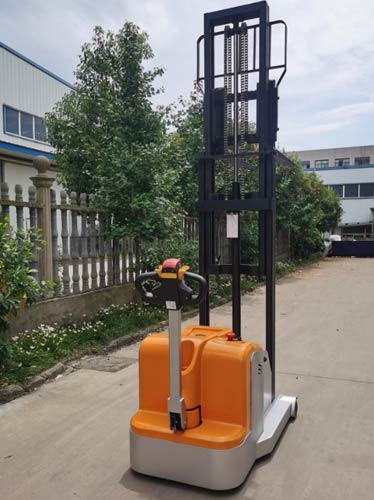
It works well for small raw material warehouses and store back storage areas with dozens of replenishment cycles per day and short walking routes. It is easy to learn, and new operators can master it quickly. Its drawback is operator fatigue after long hours of work. It consumes much physical strength during repeated transfers and is not fit for two-shift high-intensity operations.
The stand-on counterbalance stacker comes with an operator platform. Operators stay on board instead of walking along the route, ideal for long-distance transfer and high-frequency continuous stacking. It is widely used in auto parts and finished packaging transit warehouses with nonstop inbound and outbound tasks, reducing operator fatigue and maintaining stable performance for long shifts.
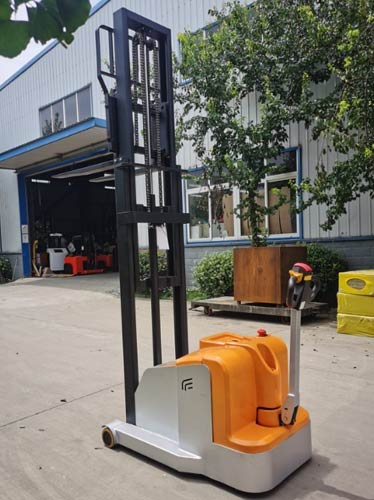
Its counterweight and chassis frame are reinforced for smoother control during heavy-load high stacking. Guardrails are optional on some models for extra safety protection. Its downside is the longer body, which requires a wider stacking aisle. Its purchase price and long-term maintenance cost are higher than the walk-behind model.
Make your choice based on daily operation hours and transfer distance. Pick the walk-behind counterbalance stacker for short-distance, low-frequency tasks with limited budget and tight aisles. The stand-on version is better for long routes, large cargo volume and continuous two-shift work to ease operator tiredness.
Both adopt counterbalance design and are free from pallet ground clearance limits. They only differ in operation mode. Remember to check the clear aisle width and floor condition before final selection.
-
 Legless Counterbalance Stacker: Solve Pallet Jamming ProblemsLegged stackers often jam thick pallets. Legless stand-on counterbalance stackers with rear weights handle irregular loads for workshops with mixed pallets and tool bins.
Do you like ?0
Read more -
 Reliable China Forklift Manufacturer for Warehouse Electric ForkliftsSourcing forklifts from multiple suppliers brings messy service. newnewton factory supplies full-range warehouse forklifts for spot, custom and export orders in one stop.
Do you like ?0
Read more -
 What Is the Difference Between Brushed and Brushless Forklift Drive MotorsBrushed and brushless drive motors differ in carbon brushes. Choose forklift motors by dust, working hours and maintenance instead of price alone.
Do you like ?0
Read more -
 Why Manual Pallet Jack Quotes Vary? Wheel Cost BreakdownPrice gaps of 2.5t manual pallet trucks mostly come from wheels. Nylon, PU and rubber wheels suit different floors. Cheap models often cut corners on wheels and bearings.
Do you like ?0
Read more -
 Walk-Behind vs Stand-On Counterbalance Stacker ComparisonCounterbalance stackers handle thick and special pallets. Walkie and stand-on versions have similar stacking capacity but differ in workload, aisle demand and operation experience.
Do you like ?0
Read more -
 How to Locate and Fix Steering Noise on Electric Towing TractorsElectric tow tractors often have recurring steering noise. Different sounds indicate different damaged parts. Locate faults and maintain properly to avoid repeated issues.
Do you like ?0
Read more








