
Assembly and adjustment of mechanical steering system for electric forklifts
For some electric forklifts or tractors that use mechanical steering systems, when the steering wheel, steering shaft, mechanical steering gear, longitudinal rod, tie rod, and other components are installed in the corresponding positions of the forklifts, Jiangsu electric forklift manufacturers believe that the initial positions of each component and system should be adjusted.
1. Adjust the position of the quick handle. Firstly, place the quick handle in the "O" position (corresponding to the driver's seat), connect the steering gear, turn the steering wheel to the left and right to their respective endpoints, record each rotation angle, and find out that the steering gear nut is in the middle position; Disconnect the steering gear from the steering shaft, place the steering wheel quick handle at "O", reconnect the steering gear, and lock it securely (other methods can also be used); Connect the steering arm, longitudinal (straight) pull, and (rotary) plate.
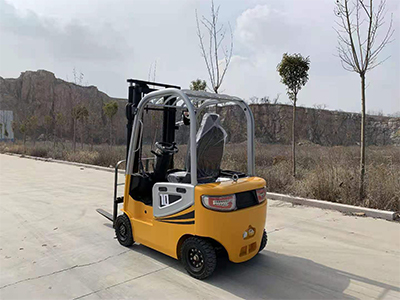
2. Electric forklift steering wheel parallel adjustment. Rotate the steering wheel to make the steering wheel travel in a straight line, and the two wheels must be parallel without toe-in or opposite states. The front and rear center values of the tire can be measured with a ruler and should be consistent, otherwise the length of the tie rod should be adjusted. When adjusting, it should be noted that the two tie rods must be of equal length, measured while adjusting, and the locking nut should be tightened after adjustment.
3. Adjustment of the steering pitman arm position. The vehicle is driving in a straight line, with the quick handle in the "O" position (with the fan in the middle of the bar), and there may be uneven left turns when turning the wheel. The steering should be folded off the steering arm shaft, turned one or several teeth, and reinstalled. Then, check the left and right steering angles until the left and right steering angles are consistent.
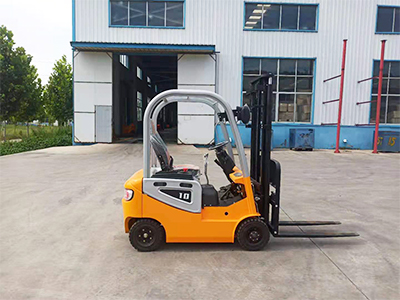
4. Inspection of the steering angle of electric forklifts. Use a jack to lift the steering axle and keep the rear wheels in a straight line. Then, place a flat plate on the left and right tires and fix a piece of white paper on the plate. Use a ruler to approach the edge of the wheel and draw a straight line parallel to the wheel; Then turn the square to the extreme position and draw the second straight line b; Use a protractor to measure the angle between two straight lines as the maximum turning angle in a certain direction.
If the maximum steering angle specified by the vehicle is reached, the limit bolt fixed on the steering axle can be adjusted to limit the maximum inner steering angle of the steering wheel. Use the same method to adjust the maximum inner steering angle of the other wheel. If the maximum steering angle cannot be adjusted due to improper steering angle, it can be adjusted according to the above method until the maximum outer and maximum inner steering angles of each wheel meet the requirements (various electric vehicles should follow the values given in the manual), and then lock the steering axle limit screw firmly. Note: For a fully hydraulic steering system, the initial position can also be adjusted using the above method.
Electric forklift
5. Inspection and adjustment of free rotation of electric forklift square plates. The amount of free rotation of the steering wheel (the clearance of the steering wheel) directly affects the handling performance of the vehicle. If the amount of free rotation is too small, it will make the steering heavy, difficult to handle, and accelerate wear. If it is too large, it will reduce the steering sensitivity and affect driving safety.
When checking the free rotation of the steering wheel, place the vehicle in a straight parking position, clamp the dial and pointer of the free rotation tester on the steering pipe and steering wheel respectively, and turn the steering wheel to the left and right until there is just resistance. The free rotation of this section without resistance varies depending on the vehicle model, generally ranging from 10 ° to 15 °. When it exceeds 25 °, it should be adjusted, Mainly adjust the meshing clearance of the steering gear and the clearance of each joint of the steering transmission mechanism. (Jiangsu electric forklift manufacturer checks the full hydraulic steering system of electric forklifts. Check the clearance between the steering column and the connecting boss, as well as the connection clearance between the joints of the steering transmission mechanism.).
-
 Reliability Of Newnewton Warehouse Forklifts For Heavy-Duty ShiftsWarehouse forklift reliability relies on industrial parts, reinforced frames and factory durability tests. Proper operation and maintenance reduce unexpected downtime.
Do you like ?0
Read more -
 Forklift Configuration Strategy For Dense Warehousing, Warehouse ForkliftDense warehousing needs matched forklifts besides racks. Reach and trilateral stackers fit different layouts, coordinate aisle, load curve and floor for smooth handling.
Do you like ?0
Read more -
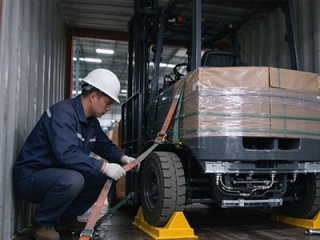 Full Container Supply For Export Forklifts, Forklift ManufacturerBulk forklift orders for overseas can ship by FCL or LCL. Newnewton FCL offers stable freight, safer packing and mixed models for large purchases.
Do you like ?0
Read more -
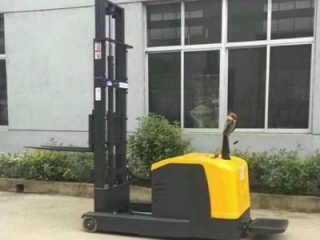 Stand-on Reach Stacker For Narrow Aisle Stacking, Mast Reach StructureStand-on reach stackers feature sliding masts that stay outside racks. They boost storage density in narrow aisles and require flat floors and standard pallets.
Do you like ?0
Read more -
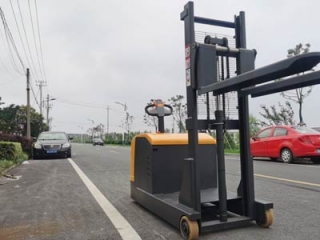 Stand-on Counterbalance Stacker For Various Pallets, Why No Leg RestrictionCounterbalance stackers have no front outriggers, using rear counterweight to avoid pallet interference. They fit various odd pallets yet need wider warehouse aisles.
Do you like ?0
Read more -
 Custom Walk-Behind Counterbalance Stacker | Non-Standard ModificationsStandard walk-behind counterbalance stackers struggle with non-standard pallets and tight aisles. Customize load, lift, forks and structure, share working conditions for safe design.
Do you like ?0
Read more








