Is Off‑Road Walk‑Behind Pallet Truck Easy to Operate? Operator Training Guide
When handling cargo on complex outdoor terrain, managers and operators often have concerns: only off‑road pallet trucks can deliver efficient performance, but is off‑road walk‑behind pallet truck easy to operate? Is it safe? How much training time is required before operators can get proficient? This article answers these questions in detail.
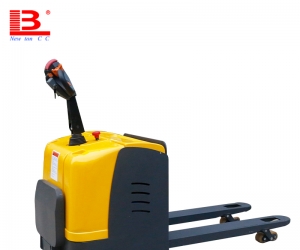
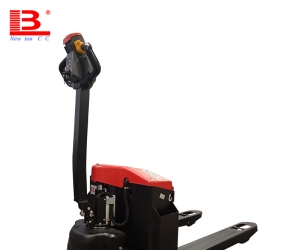
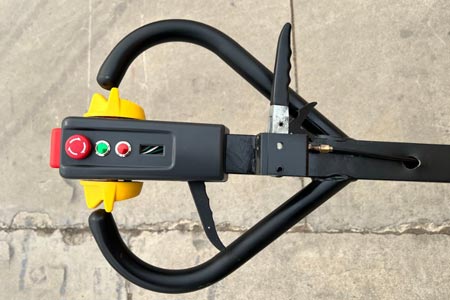
From the hardware‑control perspective, the handle integrates forward, reverse, lifting‑lowering and emergency‑stop buttons with simple electric logic. Operators experienced with standard electric pallet jacks can master basic movements within 1‑2 hours. Complete theoretical plus hands‑on training enables zero‑experience staff to grasp fundamental operations within half a day.
The real difficulty lies not in button manipulation, but in terrain judgment and speed control under rough‑ground conditions. Higher speed is acceptable on flat indoor floors, yet low‑speed steady handling is mandatory for off‑road scenarios. Many safety accidents occur when operators apply indoor operating habits: sharp acceleration, sudden braking or turning on uneven ground may trigger cargo sliding or vehicle skidding loss‑of‑control.
Theoretical Training (1‑2 hours)
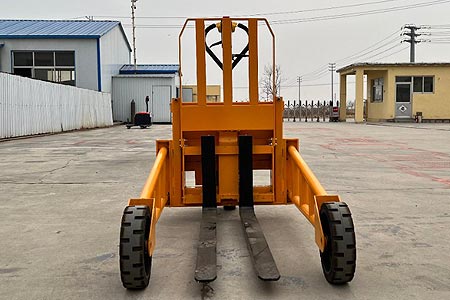
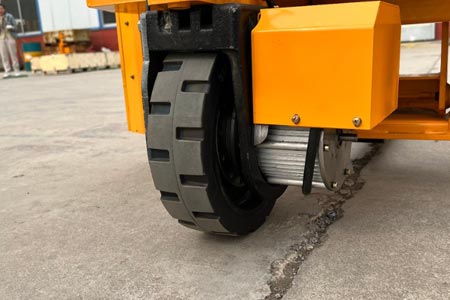
Equipment familiarization: Learn overall structure including deep‑tread off‑road tires, increased ground clearance, waterproof electric control and motor protection functions. Understand rated load capacity. Reserve 10 % load margin for off‑road conditions; overload and offset‑load operation are strictly forbidden. Overloading on bumpy ground easily damages frames and motors.
Environmental hazard briefing: Risks from muddy, gravel‑strewn, potholed and sloped ground. Traction drops on muddy surfaces and causes drive‑wheel spin‑out. Never travel cross‑slope on ramps; only straight uphill or downhill travel is permitted. Water‑wading depth cannot exceed half of tire height to avoid short‑circuit damage to motors and controllers.
Safety‑component awareness: Emergency‑stop button, brake system and overload protection. Clarify scenarios requiring immediate emergency‑stop shutdown.
Pre‑shift inspection requirements: Before every shift, examine the off‑road full‑electric pallet truck. Check tires for trapped steel bars or gravel, bolt tightness, hydraulic leakage and closed battery‑compartment waterproof cover, as well as brake responsiveness. Never operate a faulty unit.
Hands‑on Practical Training (2‑4 hours, progressive practice)
Basic exercises on flat ground: Practice pallet picking, lifting‑lowering, forward‑reverse travel, steering and start‑stop. Get familiar with smooth handle speed adjustment and avoid abrupt force on controls.
Simulated bumpy‑terrain practice: Travel at low speed across gravel ground, practice minor steering correction without sharp turning. Keep full‑load travelling speed of off‑road pallet trucks within 3‑5 km/h, equivalent to normal walking pace.
Ramp practice: Perform straight uphill and downhill runs. Keep cargo center‑of‑gravity low with forks close to ground. In‑slope turning and on‑spot U‑turns are prohibited.
Fault simulation drills: Practice emergency shutdown and correct responses to wheel spin‑out, abnormal noise and tilted cargo.
Industry practical statistics show that fully‑trained operators reduce equipment failure rates by 48 %. Untrained on‑the‑job staff face greatly elevated risks of electric‑system and wheel‑assembly damage under bumpy working conditions.
Core daily‑operation key points
Transport cargo at low fork height, keep forks 5‑10 cm above ground. Higher lifting raises center‑of‑gravity and multiplies skidding risk on uneven ground.
Do not force‑drive over large pits or protruding steel bars. Place steel plates or take detours to prevent chassis impact, frame deformation and hydraulic‑hose rupture.
Accelerate gently on slippery muddy ground. Avoid heavy‑current rushing; sustained wheel spin‑out leads to motor overheating damage.
After finishing work, clear gravel and mud trapped in tire treads and complete simple equipment checks before power‑off.
With this guide, enterprises can understand operation workflows and training procedures for the off‑road full‑electric pallet truck. We can supply operation manuals and concise training documents. Operators must pass both theoretical and practical internal assessment before independent work authorization.
-
 Reliability Of Newnewton Warehouse Forklifts For Heavy-Duty ShiftsWarehouse forklift reliability relies on industrial parts, reinforced frames and factory durability tests. Proper operation and maintenance reduce unexpected downtime.
Do you like ?0
Read more -
 Forklift Configuration Strategy For Dense Warehousing, Warehouse ForkliftDense warehousing needs matched forklifts besides racks. Reach and trilateral stackers fit different layouts, coordinate aisle, load curve and floor for smooth handling.
Do you like ?0
Read more -
 Full Container Supply For Export Forklifts, Forklift ManufacturerBulk forklift orders for overseas can ship by FCL or LCL. Newnewton FCL offers stable freight, safer packing and mixed models for large purchases.
Do you like ?0
Read more -
 Stand-on Reach Stacker For Narrow Aisle Stacking, Mast Reach StructureStand-on reach stackers feature sliding masts that stay outside racks. They boost storage density in narrow aisles and require flat floors and standard pallets.
Do you like ?0
Read more -
 Stand-on Counterbalance Stacker For Various Pallets, Why No Leg RestrictionCounterbalance stackers have no front outriggers, using rear counterweight to avoid pallet interference. They fit various odd pallets yet need wider warehouse aisles.
Do you like ?0
Read more -
 Custom Walk-Behind Counterbalance Stacker | Non-Standard ModificationsStandard walk-behind counterbalance stackers struggle with non-standard pallets and tight aisles. Customize load, lift, forks and structure, share working conditions for safe design.
Do you like ?0
Read more