
Many warehouse operators wonder how to operate ride-on electric pallet mover correctly. This type of ride-on full electric pallet truck is widely used for medium and long-distance frequent cargo transport, yet improper operation will reduce work efficiency and bring safety risks.
Complete pre-operation inspection before starting work. Never use faulty equipment to prevent cargo falling, breakdowns and personal injury accidents.
Battery check: Check the power level on the dashboard. Stop operation and charge the machine when power is insufficient, to avoid sudden power cut, hydraulic jam or travelling failure during handling.
Visual inspection: Check frame, guardrail and standing platform for deformation, cracks or loose parts. Inspect tyres for damage and heavy wear, and clear stones or wires stuck between tyres to guarantee smooth travel.
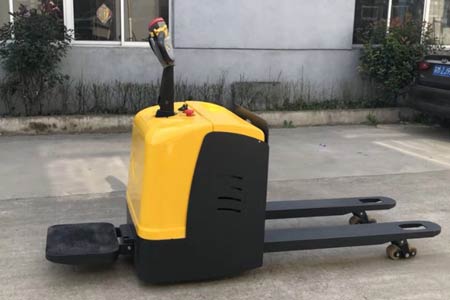
Hydraulic system check: Check oil cylinder, pipelines and connectors for oil leakage. Ensure lifting chains and rollers run smoothly without jamming, abnormal noise or offset.
Control system check: Test the control handle reset function. Verify forward, backward and lifting buttons are responsive, brakes work reliably and emergency stop button resets normally.
Working environment check: Remove debris, water and oil from aisles to keep ground flat and dry. For narrow aisles, confirm shelf clearance and clear irrelevant personnel and obstacles to reserve enough space for travelling and turning.
After preparation, slowly drive the machine toward the pallet. Align two forks parallel with pallet openings, move forward at low speed and fully insert forks under the pallet. Avoid partial or tilted insertion. Check cargo stability, lift forks to raise goods 10-20cm off the ground.
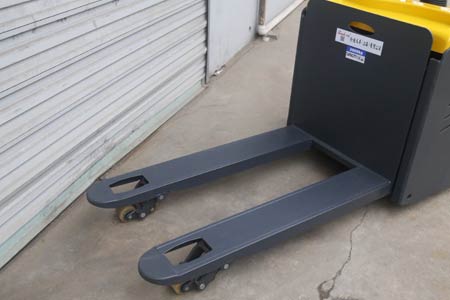
Keep low speed while transporting loaded pallets. No rapid acceleration or sudden braking. Drive in the middle of warehouse aisles and slow down in corners. Watch out for pedestrians and racking. Never overload or place cargo off-center. It is forbidden to carry passengers or stand on areas outside the platform of the ride-on full electric pallet truck.
When arriving at unloading spot, stop the vehicle steadily. Lower forks slowly until the pallet rests firmly on the ground, then back out at low speed to finish unloading. When travelling empty, keep forks at the lowest position to prevent collision damage.
After work, park the machine in designated warehouse area instead of main passage. Lower forks completely, reset control handle, turn off key switch and activate emergency stop for locking. Clean dust and debris on the machine, check component wear, and charge the vehicle if battery power is low.
Master standard operating rules for how to operate ride-on electric pallet mover to realize safe and efficient warehouse handling. Leave your aisle width and load requirement to get matched model recommendation.
-
 Reliability Of Newnewton Warehouse Forklifts For Heavy-Duty ShiftsWarehouse forklift reliability relies on industrial parts, reinforced frames and factory durability tests. Proper operation and maintenance reduce unexpected downtime.
Do you like ?0
Read more -
 Forklift Configuration Strategy For Dense Warehousing, Warehouse ForkliftDense warehousing needs matched forklifts besides racks. Reach and trilateral stackers fit different layouts, coordinate aisle, load curve and floor for smooth handling.
Do you like ?0
Read more -
 Full Container Supply For Export Forklifts, Forklift ManufacturerBulk forklift orders for overseas can ship by FCL or LCL. Newnewton FCL offers stable freight, safer packing and mixed models for large purchases.
Do you like ?0
Read more -
 Stand-on Reach Stacker For Narrow Aisle Stacking, Mast Reach StructureStand-on reach stackers feature sliding masts that stay outside racks. They boost storage density in narrow aisles and require flat floors and standard pallets.
Do you like ?0
Read more -
 Stand-on Counterbalance Stacker For Various Pallets, Why No Leg RestrictionCounterbalance stackers have no front outriggers, using rear counterweight to avoid pallet interference. They fit various odd pallets yet need wider warehouse aisles.
Do you like ?0
Read more -
 Custom Walk-Behind Counterbalance Stacker | Non-Standard ModificationsStandard walk-behind counterbalance stackers struggle with non-standard pallets and tight aisles. Customize load, lift, forks and structure, share working conditions for safe design.
Do you like ?0
Read more








