
Key Parameters For Sourcing 8‑m Self‑Propelled Scissor Lift Platform
Purchasers shall evaluate performance, specifications and applicable working conditions when selecting scissor lift. This article explains key selection criteria from parameter perspective, to avoid common issues such as insufficient load capacity or poor site accessibility after equipment arrival.
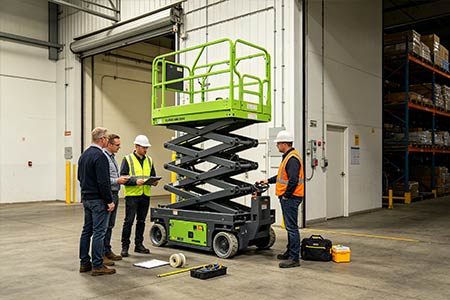
Distinguish working height from platform height to prevent parameter misunderstanding. Some suppliers mix‑up these two indicators and mark platform height as model name, resulting in failure to meet expected working height on site. Refer to national standard GB/T 25849 for aerial work platforms, verify rated working height and platform lifting height on datasheet to match real‑site requirements. For example, the 8‑meter model means maximum working height, while actual platform height from ground is around 6 m. Keep this difference in mind during procurement.
Rated platform load capacity, calculate total weight of personnel plus materials. The 8‑m self‑propelled scissor lift platform has standard and heavy‑duty variants, with rated load ranging from 230 kg‑450 kg. Calculate total weight of operators, tools and materials instead of only estimating human body weight.
Pick higher‑capacity models if two to three workers need to operate with pipes and tools simultaneously. Standard light‑duty version is enough for single‑person maintenance work. Never overload; overloading may cause scissor arm deformation and tipping hazard.
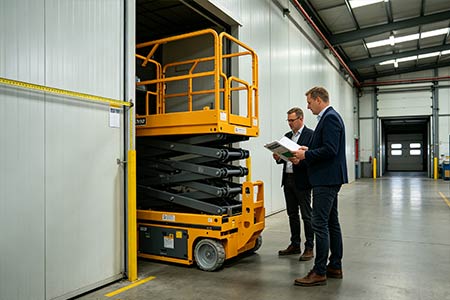
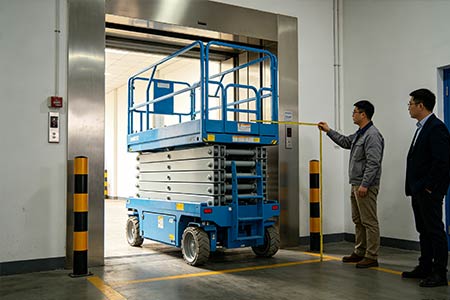
Overall dimension & accessibility for doorways and aisles. Self‑propelled scissor lift needs to pass factory gates, freight elevators and workshop aisles. Overall length, width and folded height are critical parameters. Excessive folded height blocks standard factory doorways; over‑wide body brings difficulty turning in narrow aisles.
If elevator access is required, check machine dead weight against elevator load limit. Some units are equipped with foldable guardrails to reduce folded height for smoother doorway passage.
Travel drive mode: battery‑powered unit with proper battery configuration. DC battery‑driven self‑propelled scissor lift is preferred for indoor factory tasks with zero exhaust and low noise. Pay attention to battery capacity. Large‑capacity lithium‑ion version with fast‑charging function suits high‑intensity all‑day operation. Lead‑acid battery is acceptable for low‑frequency usage.
Confirm whether travel is available at full lifting height. Some low‑cost units can only move on ground instead of travelling when elevated, which greatly reduces high‑altitude shifting efficiency.
8‑m self‑propelled scissor lift platform is a widely‑used standard specification. Contact us to get free quotation, digital catalog and demo videos for further reference.
-
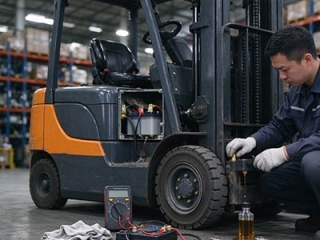 Reliability Of Newnewton Warehouse Forklifts For Heavy-Duty ShiftsWarehouse forklift reliability relies on industrial parts, reinforced frames and factory durability tests. Proper operation and maintenance reduce unexpected downtime.
Do you like ?0
Read more -
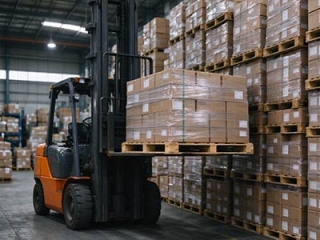 Forklift Configuration Strategy For Dense Warehousing, Warehouse ForkliftDense warehousing needs matched forklifts besides racks. Reach and trilateral stackers fit different layouts, coordinate aisle, load curve and floor for smooth handling.
Do you like ?0
Read more -
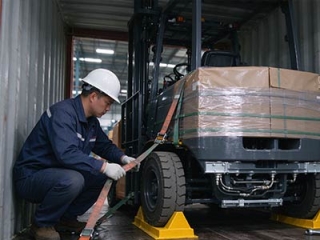 Full Container Supply For Export Forklifts, Forklift ManufacturerBulk forklift orders for overseas can ship by FCL or LCL. Newnewton FCL offers stable freight, safer packing and mixed models for large purchases.
Do you like ?0
Read more -
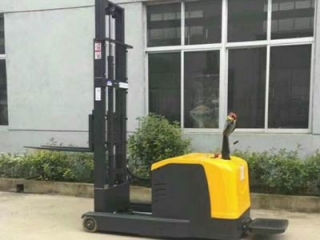 Stand-on Reach Stacker For Narrow Aisle Stacking, Mast Reach StructureStand-on reach stackers feature sliding masts that stay outside racks. They boost storage density in narrow aisles and require flat floors and standard pallets.
Do you like ?0
Read more -
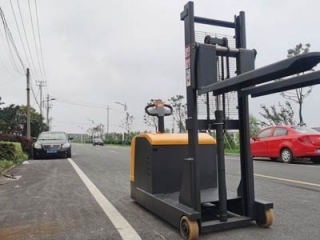 Stand-on Counterbalance Stacker For Various Pallets, Why No Leg RestrictionCounterbalance stackers have no front outriggers, using rear counterweight to avoid pallet interference. They fit various odd pallets yet need wider warehouse aisles.
Do you like ?0
Read more -
 Custom Walk-Behind Counterbalance Stacker | Non-Standard ModificationsStandard walk-behind counterbalance stackers struggle with non-standard pallets and tight aisles. Customize load, lift, forks and structure, share working conditions for safe design.
Do you like ?0
Read more








