
How Is Semi-electric Stacker | Pros & Cons Of Economical Semi-electric Stacker
If you run stacking operations in compact storage spaces, this article answers the key question How Is Semi-electric Stacker. We sort out all advantages, drawbacks and price ranges of the Economical Semi-electric Stacker, helping you evaluate its cost performance and site adaptability for your warehouse.
Core Structure Of Economical Semi-electric Stacker
It adopts dual working modes: electric hydraulic lifting + manual pushing. Key components include thickened C-section steel mast, integrated sealed hydraulic power unit, maintenance-free lead-acid battery and foot parking brake. Without travel drive motors, the whole machine features a simplified structure with fewer fault points. Operators do not require professional forklift certificates and can master operation instantly.
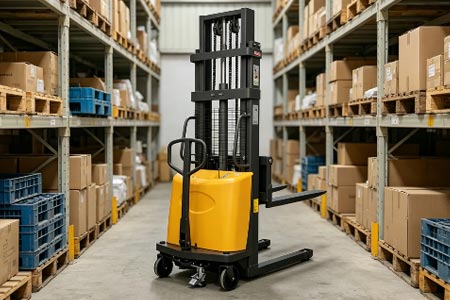
Four Major Advantages
Low upfront procurement budget Mainstream 1t & 1.5t economical models are priced at ¥5,200–9,000, nearly half the cost of equal-capacity full electric stackers. Small enterprises and retail shops avoid heavy capital investment with fast payback cycles.
Compact body fits narrow small warehouses No standing footplate or drive housing keeps the unit ultra-slim. It works smoothly in aisles as narrow as 2.6m, and navigates tight spaces such as mezzanine floors, freight elevators and assembly line corners. It can be stored against walls without occupying valuable storage space when idle.
Electric lifting reduces labor strain Fork lifting is powered by electric hydraulics with smooth one-button lifting, easily hoisting 1.5-ton loads. Compared with fully manual stackers, it drastically cuts waist fatigue for staff during long-hour stacking work.
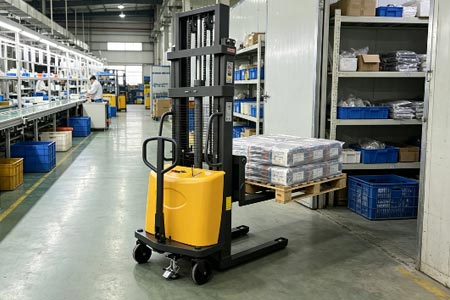
Simple maintenance lowers long-term operating cost Fewer electrical components only require regular inspection of batteries, hydraulic oil and wheel pins. Warehouse staff can complete basic maintenance independently. Spare parts are cheap and widely available, with annual maintenance costs only around one hundred RMB.
Main Limitations
Labor-intensive for long-distance heavy-load transfer Travel relies entirely on manpower. Pushing fully loaded 1.5t goods over 30 meters is physically exhausting, making it unsuitable for warehouses with hundreds of long-distance transport cycles daily.
Only applicable for flat indoor floors No electric traction assistance creates huge rolling resistance on slopes, gravel or uneven ground. It is restricted to indoor warehouses with flat epoxy or cement flooring.
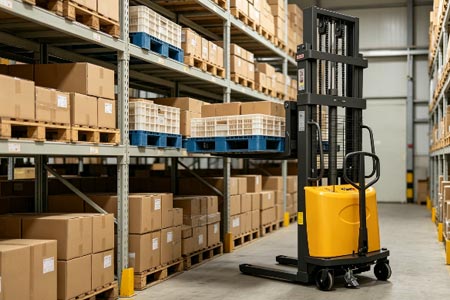
Short battery runtime for low-frequency use Standard lead-acid batteries support continuous operation for only 3–4 hours per full charge. It fits warehouses with dozens of stacking cycles per day, not recommended for two-shift high-intensity storage facilities.
Load capacity drops sharply at extra-high lifting heights Rated load declines significantly when lifting above 3.5m. It delivers optimal performance for racks under 2.5m in small warehouses.
Selection Summary
This guide delivers solid reference value if you plan to purchase an Economical Semi-electric Stacker for small storage sites and want to figure out How Is Semi-electric Stacker. Feel free to contact us for further consultation on model matching and quotations.
-
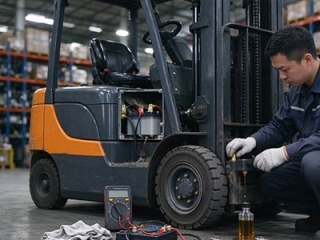 Reliability Of Newnewton Warehouse Forklifts For Heavy-Duty ShiftsWarehouse forklift reliability relies on industrial parts, reinforced frames and factory durability tests. Proper operation and maintenance reduce unexpected downtime.
Do you like ?0
Read more -
 Forklift Configuration Strategy For Dense Warehousing, Warehouse ForkliftDense warehousing needs matched forklifts besides racks. Reach and trilateral stackers fit different layouts, coordinate aisle, load curve and floor for smooth handling.
Do you like ?0
Read more -
 Full Container Supply For Export Forklifts, Forklift ManufacturerBulk forklift orders for overseas can ship by FCL or LCL. Newnewton FCL offers stable freight, safer packing and mixed models for large purchases.
Do you like ?0
Read more -
 Stand-on Reach Stacker For Narrow Aisle Stacking, Mast Reach StructureStand-on reach stackers feature sliding masts that stay outside racks. They boost storage density in narrow aisles and require flat floors and standard pallets.
Do you like ?0
Read more -
 Stand-on Counterbalance Stacker For Various Pallets, Why No Leg RestrictionCounterbalance stackers have no front outriggers, using rear counterweight to avoid pallet interference. They fit various odd pallets yet need wider warehouse aisles.
Do you like ?0
Read more -
 Custom Walk-Behind Counterbalance Stacker | Non-Standard ModificationsStandard walk-behind counterbalance stackers struggle with non-standard pallets and tight aisles. Customize load, lift, forks and structure, share working conditions for safe design.
Do you like ?0
Read more








