Weak Lifting Failure of Stand-On Counterbalance Stacker & Repair Solutions
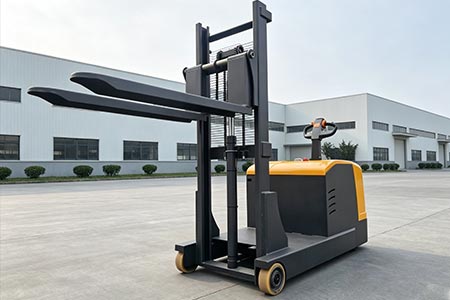
Stop operating immediately once you encounter weak lifting of stand-on counterbalance stacker during warehouse handling to avoid potential safety hazards. This frequent malfunction is generally caused by hydraulic system faults, power supply problems or worn mechanical components. This article shares practical fault analysis and counterbalance stacker maintenance solutions.
Insufficient or deteriorated hydraulic oil Fault performance: Normal lifting without load, obviously weak lifting and slow movement under loaded conditions. Analysis: Shortage of oil leads to insufficient supply. Long-term service causes oil oxidation and impurity contamination, weakening lubrication and pressure transmission. Solutions: Check oil level and add anti-wear hydraulic oil of the same model. Replace all hydraulic oil thoroughly if it turns turbid or black, and clean the hydraulic tank filter screen simultaneously.
Low relief valve pressure or stuck valve spool Fault performance: The stacker cannot lift rated load due to premature pressure relief. Analysis: The relief valve controls system hydraulic pressure. Impurities blocking the spool or incorrect pressure setting prevent the system from reaching standard working pressure. Solutions: Disassemble and clean impurities on the relief valve. Recalibrate pressure strictly according to original factory parameters after cleaning. Never raise pressure arbitrarily to prevent pipe burst and mast damage.
Internal leakage caused by aging hydraulic cylinder seals Fault performance: Forks slide slowly after reaching certain height, and loaded lifting becomes difficult. Analysis: Long-time friction ages oil seals, resulting in internal oil backflow and continuous pressure loss inside the cylinder. Solutions: Disassemble the cylinder and replace the whole seal kit. Check cylinder wall for scratches; repair or replace the entire cylinder assembly if the cylinder is damaged.
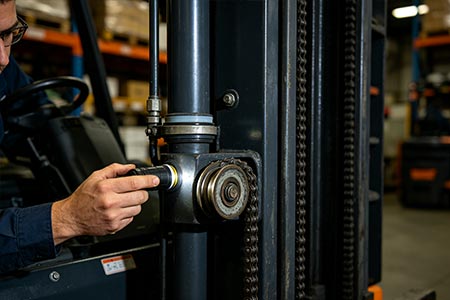
Worn hydraulic pump leading to insufficient oil supply Fault performance: Obvious abnormal noise of the lifting motor during operation, slow lifting speed both with and without cargo. Analysis: Worn gears or blades reduce volumetric efficiency, so the pump fails to provide adequate flow and pressure. Solutions: Test the output pressure of the pump. Minor wear can be fixed via maintenance; replace the whole hydraulic pump assembly for severe wear.
Low battery voltage and poor wire connection Fault performance: Voltage drops sharply when activating lifting, resulting in insufficient lifting power. Analysis: Aged batteries lose capacity; oxidized or loose terminals stop the lifting motor from getting rated voltage. Solutions: Test battery voltage under no-load and loaded conditions. Remove oxide on terminals and fasten wiring. Replace battery packs when aging is severe.
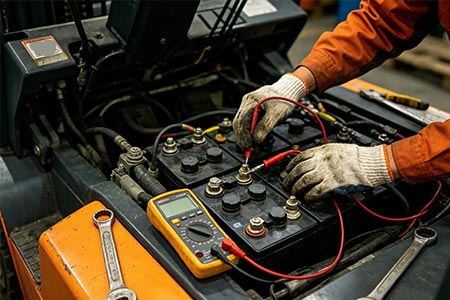
Lifting motor malfunction Fault performance: The motor runs weakly and heats rapidly after pressing the lifting button. Analysis: Worn carbon brushes or partially aging coils reduce motor output power. Solutions: Replace worn carbon brushes. Change the lifting motor if coils suffer short circuit or aging.
Stuck mast rollers and failed lubrication Fault performance: Stuttering movement and friction noise during lifting, causing strenuous lifting. Analysis: Rusty roller bearings and insufficient grease greatly increase friction of the mast. Solutions: Clear debris on mast rails, inspect worn rollers, apply special lubricating grease and adjust mast clearance.
Feel free to contact us if you have questions regarding counterbalance stacker maintenance mentioned above.
-
 Reliability Of Newnewton Warehouse Forklifts For Heavy-Duty ShiftsWarehouse forklift reliability relies on industrial parts, reinforced frames and factory durability tests. Proper operation and maintenance reduce unexpected downtime.
Do you like ?0
Read more -
 Forklift Configuration Strategy For Dense Warehousing, Warehouse ForkliftDense warehousing needs matched forklifts besides racks. Reach and trilateral stackers fit different layouts, coordinate aisle, load curve and floor for smooth handling.
Do you like ?0
Read more -
 Full Container Supply For Export Forklifts, Forklift ManufacturerBulk forklift orders for overseas can ship by FCL or LCL. Newnewton FCL offers stable freight, safer packing and mixed models for large purchases.
Do you like ?0
Read more -
 Stand-on Reach Stacker For Narrow Aisle Stacking, Mast Reach StructureStand-on reach stackers feature sliding masts that stay outside racks. They boost storage density in narrow aisles and require flat floors and standard pallets.
Do you like ?0
Read more -
 Stand-on Counterbalance Stacker For Various Pallets, Why No Leg RestrictionCounterbalance stackers have no front outriggers, using rear counterweight to avoid pallet interference. They fit various odd pallets yet need wider warehouse aisles.
Do you like ?0
Read more -
 Custom Walk-Behind Counterbalance Stacker | Non-Standard ModificationsStandard walk-behind counterbalance stackers struggle with non-standard pallets and tight aisles. Customize load, lift, forks and structure, share working conditions for safe design.
Do you like ?0
Read more