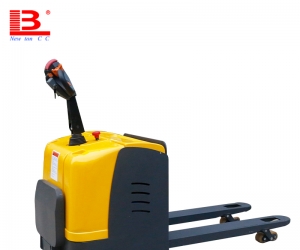
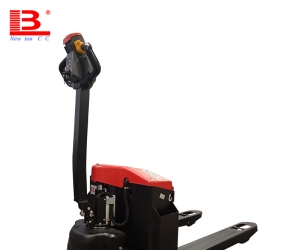
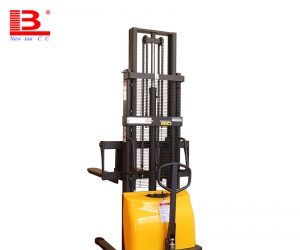
OEM customization offers practical solutions when standard forklift specifications cannot match special warehouse conditions. The stand‑on counterbalance stacker features single‑leg structure compatible with single‑sided pallets. It delivers long working endurance and solid performance, yet full‑machine customization is required for smooth operation in extremely narrow aisles.
Common customization items cover multiple aspects. Load capacity and lifting height can be adjusted on demand. For high‑level stacking and heavy‑duty tasks, manufacturers can increase mast steel thickness and counterweight mass, and conduct load‑attenuation calculation. Forks can be extended, widened or shortened to fit special‑shaped pallets, rolls and cylindrical goods.
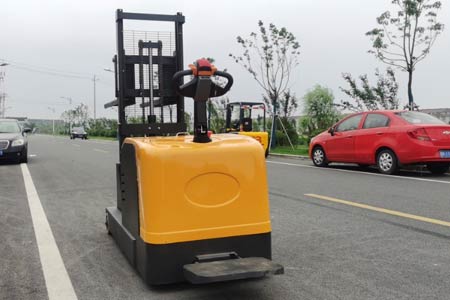
Overall machine dimensions support compact‑version customization. For confined warehouses or elevator operation, total length and width can be reduced to improve turning radius. Electrical configurations can be upgraded to lithium‑ion power systems with adjusted controller parameters. Cold‑proof kits are optional for low‑temperature working environments.
OEM branding services include body color adjustment, logo silk‑screen printing and custom packaging. Export orders can be supplied with complete CE technical documents for customs clearance. All structural modifications shall be checked in accordance with GB/T 43756‑2024 forklift design standard.
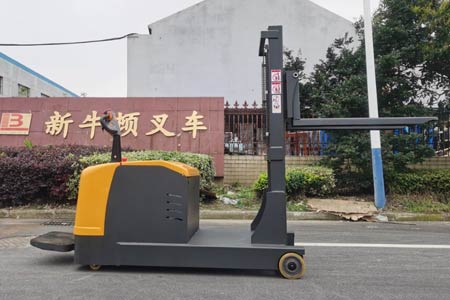
It is worth noting that simple branding does not equal non‑standard customization. Many trading companies can only finish label printing and color modification without independent structural‑design capability. Structural changes have to be outsourced, leading to unstable product quality.
Therefore, buyers should prioritize manufacturers with in‑house R&D teams, who are capable of drawing output, counterweight calculation and hydraulic matching, instead of merely modifying off‑the‑shelf units. Custom projects require complete BOM lists and inspection standards. Parameters confirmed only by verbal promises often result in products inconsistent with expectations after delivery.
Besides, verify factory production capacity, lead time and minimum order quantity. Long lead‑time for non‑standard orders and unstable mass supply will delay project implementation. Reliable counterbalance stacker OEM custom manufacturer develops tailored equipment to meet diverse demands from small‑and‑medium enterprises.
-
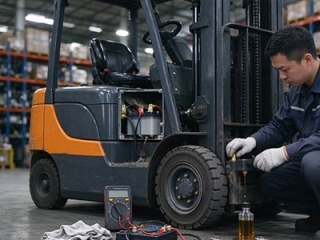 Reliability Of Newnewton Warehouse Forklifts For Heavy-Duty ShiftsWarehouse forklift reliability relies on industrial parts, reinforced frames and factory durability tests. Proper operation and maintenance reduce unexpected downtime.
Do you like ?0
Read more -
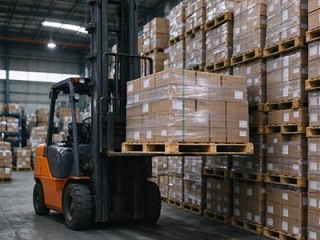 Forklift Configuration Strategy For Dense Warehousing, Warehouse ForkliftDense warehousing needs matched forklifts besides racks. Reach and trilateral stackers fit different layouts, coordinate aisle, load curve and floor for smooth handling.
Do you like ?0
Read more -
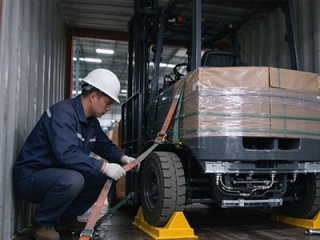 Full Container Supply For Export Forklifts, Forklift ManufacturerBulk forklift orders for overseas can ship by FCL or LCL. Newnewton FCL offers stable freight, safer packing and mixed models for large purchases.
Do you like ?0
Read more -
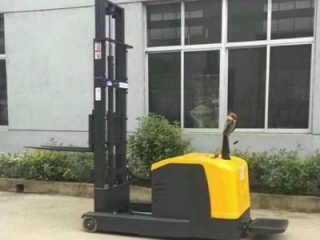 Stand-on Reach Stacker For Narrow Aisle Stacking, Mast Reach StructureStand-on reach stackers feature sliding masts that stay outside racks. They boost storage density in narrow aisles and require flat floors and standard pallets.
Do you like ?0
Read more -
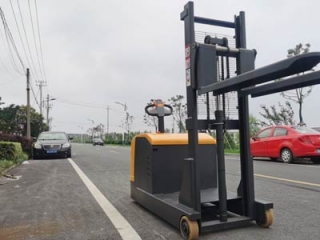 Stand-on Counterbalance Stacker For Various Pallets, Why No Leg RestrictionCounterbalance stackers have no front outriggers, using rear counterweight to avoid pallet interference. They fit various odd pallets yet need wider warehouse aisles.
Do you like ?0
Read more -
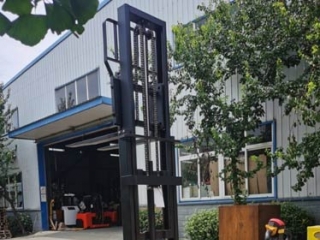 Custom Walk-Behind Counterbalance Stacker | Non-Standard ModificationsStandard walk-behind counterbalance stackers struggle with non-standard pallets and tight aisles. Customize load, lift, forks and structure, share working conditions for safe design.
Do you like ?0
Read more