3‑point forklifts are widely adopted in narrow warehouses to save storage space. Compared with four‑wheel models, the three‑point structure looks less stable, and many operators worry about roll‑over risk. Whether does 3‑wheel forklift tip over easily and what are the key safety points? This article explains its stability feature and practical operation reminders.
Stability characteristics of 3‑point forklift. The full‑electric 3‑wheel forklift keeps balance via three‑point support. Featuring compact turning radius, it suits narrow‑aisle warehouses with aisle width of 2.8‑3.2 m. Qualified factory‑produced units have passed full‑machine stability test complying with TSG 81‑2022 industrial vehicle regulation.
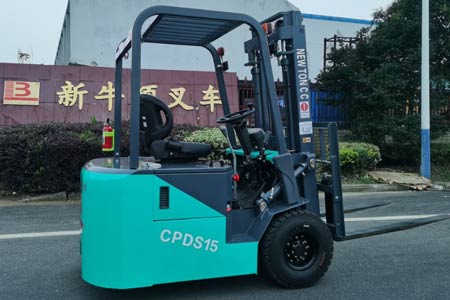
Nevertheless, it has lower lateral stability margin than four‑wheel forklifts and is more sensitive to lateral force. The tipping risk will rise obviously under certain working conditions, which is inherent structural feature instead of product quality defect.
Four main trigger factors for tip‑over accidents. Overload or offset cargo gravity. Eccentric load and single‑side heavy load on forks will destroy lateral stability, which is one of the most common causes of tipping.
Excessive turning speed. High‑speed turning with loaded goods generates centrifugal force and brings high side‑over risk. Sharp loaded turning is strictly forbidden for 3‑wheel forklifts.
Poor ground conditions. Turning or lifting on slopes, potholed floors will break three‑point supporting balance. Hazards may occur even under rated load capacity.
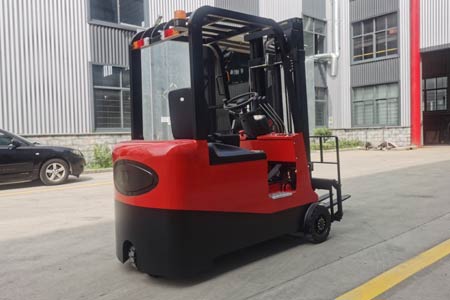
High‑speed travelling with raised mast. Higher lifting height raises overall center‑of‑gravity and reduces stability. Only low‑speed fine‑tuning is allowed under high lifting status; long‑distance high‑speed travel is prohibited.
Critical operation precautions. Reduce travelling speed under load and slow down in advance before turning. Avoid sharp steering. Place cargo in central position and reject eccentric loading.
Drive straight up and down slopes only. Never turn or travel crosswise on ramps. Repair pits and bulges on floor, do not operate on damaged ground.
Slow down when goods are lifted high, only short‑distance fine adjustment is permitted instead of high‑speed transfer. Operators shall hold valid industrial vehicle certificate and get familiar with unique handling features of 3‑wheel forklift.
Follow standardized operation and master above notes to improve operation safety of full‑electric 3‑wheel forklift.
-
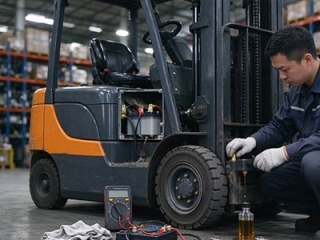 Reliability Of Newnewton Warehouse Forklifts For Heavy-Duty ShiftsWarehouse forklift reliability relies on industrial parts, reinforced frames and factory durability tests. Proper operation and maintenance reduce unexpected downtime.
Do you like ?0
Read more -
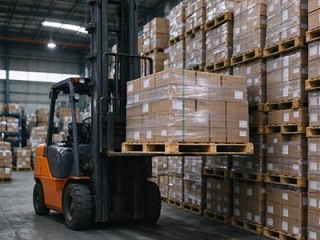 Forklift Configuration Strategy For Dense Warehousing, Warehouse ForkliftDense warehousing needs matched forklifts besides racks. Reach and trilateral stackers fit different layouts, coordinate aisle, load curve and floor for smooth handling.
Do you like ?0
Read more -
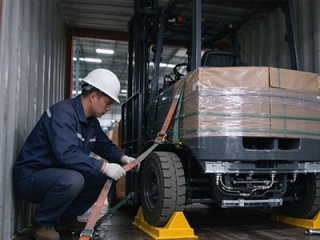 Full Container Supply For Export Forklifts, Forklift ManufacturerBulk forklift orders for overseas can ship by FCL or LCL. Newnewton FCL offers stable freight, safer packing and mixed models for large purchases.
Do you like ?0
Read more -
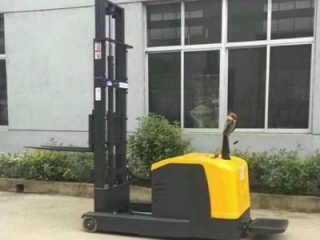 Stand-on Reach Stacker For Narrow Aisle Stacking, Mast Reach StructureStand-on reach stackers feature sliding masts that stay outside racks. They boost storage density in narrow aisles and require flat floors and standard pallets.
Do you like ?0
Read more -
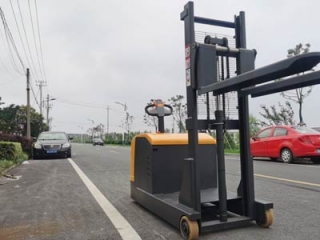 Stand-on Counterbalance Stacker For Various Pallets, Why No Leg RestrictionCounterbalance stackers have no front outriggers, using rear counterweight to avoid pallet interference. They fit various odd pallets yet need wider warehouse aisles.
Do you like ?0
Read more -
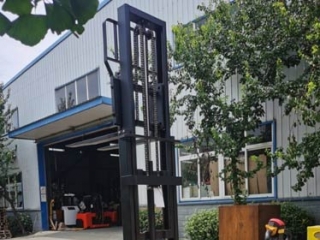 Custom Walk-Behind Counterbalance Stacker | Non-Standard ModificationsStandard walk-behind counterbalance stackers struggle with non-standard pallets and tight aisles. Customize load, lift, forks and structure, share working conditions for safe design.
Do you like ?0
Read more