Walk-behind Straddle Stacker vs Counterbalance Stacker: How to Choose
When selecting warehouse stacking equipment, you need to know the difference between walk-behind straddle stacker and counterbalance stacker. Wrong selection may cause pallet jamming, insufficient aisle space and operation restrictions. You can make the right choice according to actual working conditions after learning their core differences.
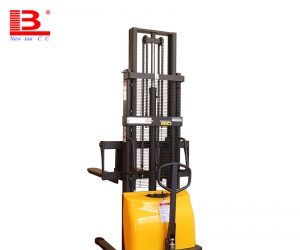
The straddle stacker relies on two front outriggers for stability without rear counterweight. It is lighter with small turning radius and lower aisle width requirement, suitable for compact ordinary warehouses. Its forks sit between the two outriggers, designed for standard open-bottom pallets, and the legs can go under pallets.
However, it cannot work with closed-bottom or solid non-standard pallets, as the outriggers will hit the pallet base. Its maximum load and lifting height are limited, mainly for medium and low stacking with standard pallets.
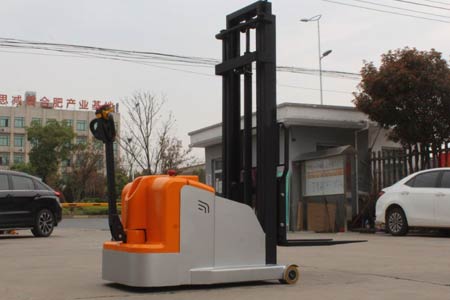
The walk-behind counterbalance stacker has no front outriggers. It uses rear counterweight to offset the load torque on forks. It is compatible with closed-bottom pallets and special irregular pallets without structural limits. It provides wider options of load capacity and lifting height with better stability for high stacking. Due to the counterweight, the machine is heavier and requires wider aisles. The ground must have enough bearing capacity; soft ground is not fit for long-term operation.
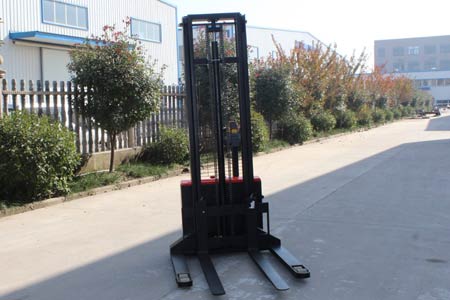
Consider pallet type and aisle width first during selection. Pick the straddle model if you only use standard open pallets in narrow aisles, it also costs less to purchase and maintain. Choose the counterbalance type if you handle closed non-standard pallets or need high stacking with enough aisle space.
Operation frequency is another factor. The lightweight straddle model is easy to move for light cargo daily transfer. The counterbalance stacker has stronger structure for heavy load and high-frequency stacking. Both types support lithium and lead-acid battery options based on your runtime demand.
These two models have obvious differences and suit different warehouse conditions. Contact us if you have further questions.
-
 2 Ton Sit-down Reach Stacker, Sit-on Electric Reach Stacker2-ton seated reach stackers fit narrow aisle high rack warehouses. Its extending mast works for two-shift stacking; watch aisle size and high lift capacity deration.
Do you like ?0
Read more -
 Walk-behind Straddle Stacker vs Counterbalance Stacker: How to ChooseWalkie straddle stackers and counterbalance stackers differ in stability. Straddle suits open pallets; counterbalance works for closed-bottom nonstandard pallets.
Do you like ?0
Read more -
 Tips on Selecting Tonnage for Small Manual Pallet JackDo not select manual pallet trucks only by cargo weight. Calculate total load including pallets and reserve safety margin for stable handling.
Do you like ?0
Read more -
 Electric Self-loading Lift Truck Wearing Parts, Electric Self-loading Lift TruckElectric self-loading trucks wear fast on delivery. Prepare spare seals, wheels, electric plugs, valve springs and pins to reduce downtime.
Do you like ?0
Read more -
 How Much Is Electric Double Pallet Truck, Double Pallet Electric Pallet JackElectric double pallet jacks have 3 tiers. Lead acid for light duty, fast-charging lithium for two-shift work. Check specs to avoid false capacity marking.
Do you like ?0
Read more -
 Scissor Lift Safety Precautions, Mobile Scissor Lift PlatformMobile scissor lifts serve factory and warehouse maintenance. Check outriggers and safety devices before use, follow operation rules and maintain regularly.
Do you like ?0
Read more