
Stacker Trucks Mast Straightening Guide | Manual Hydraulic Stacker Truck Repair
Long-term use of manual hydraulic stacker truck often causes C-channel mast twisting, tilting and bending due to overload, unbalanced load and accidental collision. For most warehouse operators, replacing new stacker trucks costs a lot, while outsourcing minor mast repair is uneconomical. This professional practical tutorial teaches standard stacker trucks mast straightening & correction methods to fix slight deformation, save maintenance costs and avoid equipment replacement.
Common Causes of Stacker Trucks Mast Distortion
Unilateral offset load Long-term uneven force on single fork due to offset pallet gravity leads to unbalanced stress and mast twisting deformation.
Continuous overloading lifting Exceeding rated load causes persistent overstretching of C-channel steel mast, resulting in irreversible bending distortion.
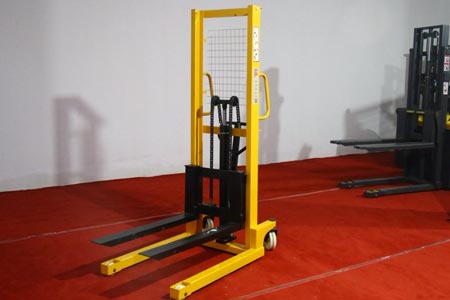
External impact and extrusion Collisions with walls or rack columns generate instantaneous impact force, bending and twisting the stacker mast.
Insufficient slide rail lubrication Dry and stuck rollers increase lifting resistance, causing local stress concentration and aggravating mast deformation.
Lifting on uneven ground Tilted truck body on rough ground produces lateral torsion on the mast during lifting, triggering twisting failure.
Complete Step-by-Step Correction for Slightly Twisted Stacker Trucks Mast
(Suitable for masts without cracks or deep creases, only slight tilt and distortion)
Fully lower and release hydraulic pressure, park the manual hydraulic stacker truck on flat cement ground, and block wheels completely to prevent displacement during correction.
Measure mast verticality with a straight ruler, mark distorted positions and record left-right offset data for accurate calibration.
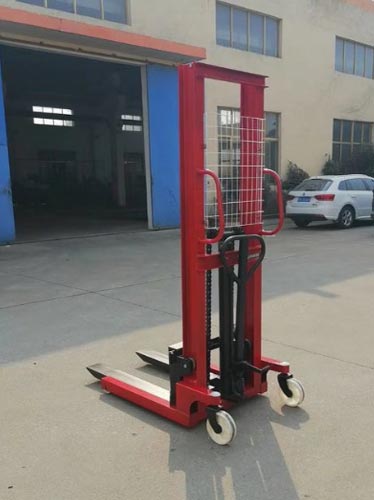
Use a jack matched with channel steel to prop the inner distorted side of the mast. Apply reverse pushing force slowly and in multiple stages. Do not apply strong force at one time to avoid steel fracture.
Conduct full-stroke fork lifting and lowering tests after each minor adjustment. Check whether jamming and offset travel are improved, and fine-tune repeatedly until lifting operation is completely smooth.
Clean impurities inside slide rails after correction, apply even lubricating grease on rollers and guide rails, and adjust bilateral roller gaps to ensure synchronous and offset-free lifting movement.
Strict Replacement Rule For Severe Mast Deformation
Do not attempt correction if the mast has obvious creases, welding cracks or steel fold stretching. Severe distortion leaves irreversible internal metal stress. Reusing modified masts under heavy load may cause sudden fracture and serious safety accidents. Replace the entire mast assembly directly, and synchronously inspect hydraulic cylinders and lifting chains for secondary damage.
Post-correction Safety Inspection Procedure
Perform 5 repeated no-load lifting cycles to confirm no jamming, offset travel or abnormal noise.
Test full-stroke lifting with standard rated load, ensure no mast shaking or tilting during operation.
Run continuous lifting for 30 minutes for re-inspection; put the stacker trucks into service only if no secondary deformation occurs.
Increase daily visual inspection frequency for one week after correction to eliminate hidden recurrence risks.
This practical guide fully complies with Q235 channel steel cold correction mechanical principles and national industrial standards. Mastering stacker trucks mast straightening & correction skills helps warehouses solve minor deformation faults efficiently, reduce equipment operation costs and extend the service life of manual hydraulic stacker truck. Feel free to contact us for more forklift maintenance knowledge!
-
 Reliability Of Newnewton Warehouse Forklifts For Heavy-Duty ShiftsWarehouse forklift reliability relies on industrial parts, reinforced frames and factory durability tests. Proper operation and maintenance reduce unexpected downtime.
Do you like ?0
Read more -
 Forklift Configuration Strategy For Dense Warehousing, Warehouse ForkliftDense warehousing needs matched forklifts besides racks. Reach and trilateral stackers fit different layouts, coordinate aisle, load curve and floor for smooth handling.
Do you like ?0
Read more -
 Full Container Supply For Export Forklifts, Forklift ManufacturerBulk forklift orders for overseas can ship by FCL or LCL. Newnewton FCL offers stable freight, safer packing and mixed models for large purchases.
Do you like ?0
Read more -
 Stand-on Reach Stacker For Narrow Aisle Stacking, Mast Reach StructureStand-on reach stackers feature sliding masts that stay outside racks. They boost storage density in narrow aisles and require flat floors and standard pallets.
Do you like ?0
Read more -
 Stand-on Counterbalance Stacker For Various Pallets, Why No Leg RestrictionCounterbalance stackers have no front outriggers, using rear counterweight to avoid pallet interference. They fit various odd pallets yet need wider warehouse aisles.
Do you like ?0
Read more -
 Custom Walk-Behind Counterbalance Stacker | Non-Standard ModificationsStandard walk-behind counterbalance stackers struggle with non-standard pallets and tight aisles. Customize load, lift, forks and structure, share working conditions for safe design.
Do you like ?0
Read more








