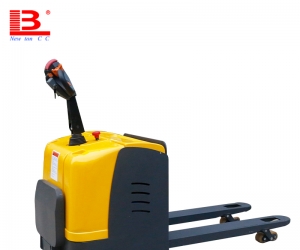
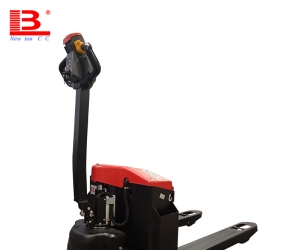
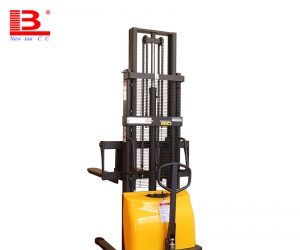
Manual VS Full Electric Stacker | Pros & Cons Comparison Guide
Choosing improper warehouse stacking equipment easily causes high costs, low efficiency and labor waste. A clear comparison of advantages and disadvantages of manual stacker and full electric stacker helps medium and small warehouse buyers make accurate selections.
Manual Hydraulic Stacker / Hydraulic Forklift Manual – Pros & Cons
Advantages
Ultra-low initial cost. Without battery, motor and electric control components, its price is only about 1/3 of a full electric stacker, featuring low investment threshold.
No charging or power supply limits. It works freely indoors and outdoors with zero endurance issues.
Simple structure and low failure rate. Few spare parts and low maintenance difficulty allow on-site staff to fix basic faults.
Lightweight and flexible steering, ideal for short-time light-load stacking in narrow spaces.
Disadvantages
Fully manual lifting and pushing. Operators suffer obvious fatigue after over 2 hours of continuous operation, and heavy-load lifting consumes massive physical strength.
Limited working efficiency. For frequent high-volume stacking tasks, its efficiency is 40%–60% lower than full electric models.
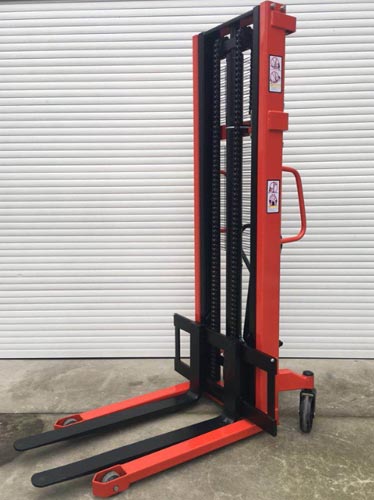
Restricted load capacity and lifting height, not applicable for heavy-duty and high-lift working conditions. Long-term high-frequency use accelerates hydraulic component wear.
Unsuitable for long-hour, high-intensity assembly line continuous operation.
Full Electric Stacker – Pros & Cons
Advantages
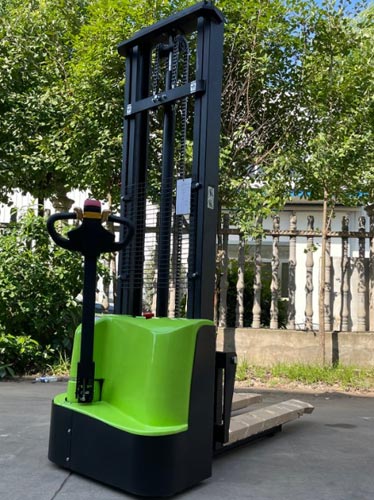
Fully electric driving and lifting greatly reduce labor intensity, supporting non-stop long-hour work. It improves stacking and warehousing efficiency by over 35% under the same conditions.
Higher load capacity and adjustable lifting height, perfectly matching high-level rack warehousing with customizable lifting parameters.
Stable operation and uniform lifting speed reduce cargo tilting risks and improve handling safety.
Perfect for long-term high-frequency transportation, assembly line supporting and daily stacking in large warehouses.
Disadvantages
Higher upfront procurement budget with larger capital pressure.
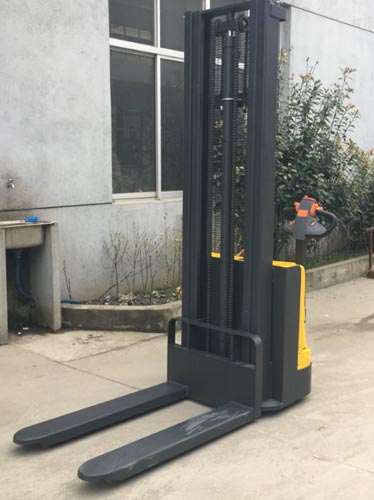
Battery-powered operation requires regular charging; spare batteries are needed for cold storage and powerless outdoor scenarios.
Equipped with motors, controllers and wiring harnesses, electric system failures bring higher maintenance costs than hydraulic forklift manual.
Standard daily battery maintenance is required; improper use shortens battery life and increases replacement expenses.
Selection Suggestions
Choose manual hydraulic stacker for low-frequency daily operation within 3 hours, occasional light-load stacking, small/temporary warehouses, budget-limited projects, 1-ton max load and low lifting height. Choose full electric stacker for high-frequency, long-hour, high-efficiency and high-lift warehouse stacking scenarios.
-
 Reliability Of Newnewton Warehouse Forklifts For Heavy-Duty ShiftsWarehouse forklift reliability relies on industrial parts, reinforced frames and factory durability tests. Proper operation and maintenance reduce unexpected downtime.
Do you like ?0
Read more -
 Forklift Configuration Strategy For Dense Warehousing, Warehouse ForkliftDense warehousing needs matched forklifts besides racks. Reach and trilateral stackers fit different layouts, coordinate aisle, load curve and floor for smooth handling.
Do you like ?0
Read more -
 Full Container Supply For Export Forklifts, Forklift ManufacturerBulk forklift orders for overseas can ship by FCL or LCL. Newnewton FCL offers stable freight, safer packing and mixed models for large purchases.
Do you like ?0
Read more -
 Stand-on Reach Stacker For Narrow Aisle Stacking, Mast Reach StructureStand-on reach stackers feature sliding masts that stay outside racks. They boost storage density in narrow aisles and require flat floors and standard pallets.
Do you like ?0
Read more -
 Stand-on Counterbalance Stacker For Various Pallets, Why No Leg RestrictionCounterbalance stackers have no front outriggers, using rear counterweight to avoid pallet interference. They fit various odd pallets yet need wider warehouse aisles.
Do you like ?0
Read more -
 Custom Walk-Behind Counterbalance Stacker | Non-Standard ModificationsStandard walk-behind counterbalance stackers struggle with non-standard pallets and tight aisles. Customize load, lift, forks and structure, share working conditions for safe design.
Do you like ?0
Read more