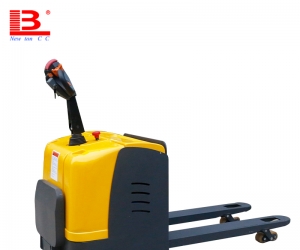
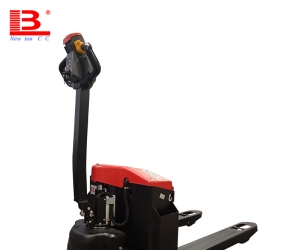
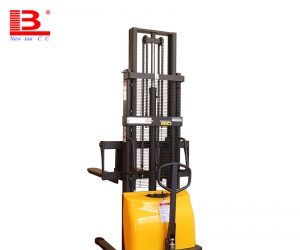
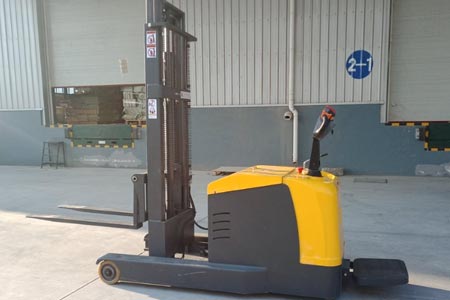
stand-on electric reach stacker is widely adopted in narrow aisle warehouses. Its movable mast and forks enable high-level stacking within aisles below 2 meters. Let’s learn about the key assemblies of the ride-on reach stacker.
Chassis Assembly Frame: Thick welded steel structure for mounting all components and bearing load impact. Drive unit: Consists of drive motor, drive wheel and electromagnetic brake, supplying power and parking brake function. Load caster wheels: Share vehicle load and ensure flexible steering. Battery compartment: Stores lead-acid or lithium battery with anti-collision protection. Shock absorber: Lessen vibration from uneven ground to protect hydraulic and electrical components.
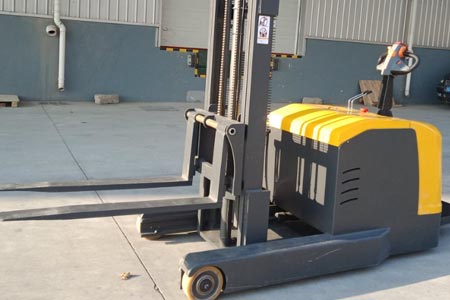
Reach Mast Assembly Reach carriage: Drives the whole mast to stretch forward and backward for goods picking. Reach cylinder: Controls extension and retraction of the carriage. Multi-stage mast: 2-stage or 3-stage free lift mast to determine maximum lifting height. Lifting cylinder: Supports mast lifting and cargo bearing. Fork assembly: Adjustable fork arms for different pallet sizes. Side rollers and guide sliders: Reduce friction and avoid jamming during operation.
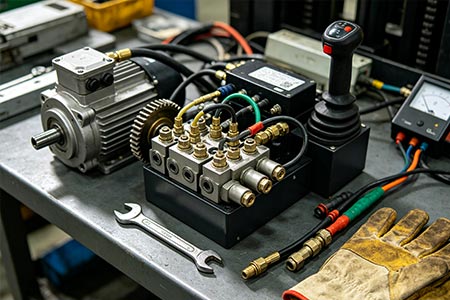
Hydraulic System Hydraulic power pack: Hydraulic motor and gear pump to generate hydraulic pressure. Multi-way control valve: Distributes oil flow to control lifting, lowering and mast movement. Hydraulic hoses and fittings: Convey hydraulic fluid. Hydraulic tank: Stores oil with built-in filter. Relief valve: Pressure protection to prevent damage caused by overload.
Electric Control System Vehicle controller: Main core managing travelling, lifting and safety signals. Contactors and wiring harness: Power transmission and circuit switching. Travel accelerator: Adjust forward, backward and driving speed. Battery indicator: Displays remaining power and fault codes. Multiple sensors: Limit, overload and brake sensors. Emergency stop button: Cuts power in emergencies for safety.
Operator Control Assembly Stand-on platform: Anti-slip standing area for operators. Safety handrails: Protect operators during stacking work. Control levers: Control mast lifting, lowering and reach movement. Steering handle: Realize left and right steering.
The stand-on electric reach stacker mainly includes five core modules: chassis assembly, reach mast assembly, hydraulic system, electric control system and operator assembly. Understanding these parts helps with daily operation and maintenance. Contact us if you need operation demonstration videos for procurement or equipment management.
-
 Reliability Of Newnewton Warehouse Forklifts For Heavy-Duty ShiftsWarehouse forklift reliability relies on industrial parts, reinforced frames and factory durability tests. Proper operation and maintenance reduce unexpected downtime.
Do you like ?0
Read more -
 Forklift Configuration Strategy For Dense Warehousing, Warehouse ForkliftDense warehousing needs matched forklifts besides racks. Reach and trilateral stackers fit different layouts, coordinate aisle, load curve and floor for smooth handling.
Do you like ?0
Read more -
 Full Container Supply For Export Forklifts, Forklift ManufacturerBulk forklift orders for overseas can ship by FCL or LCL. Newnewton FCL offers stable freight, safer packing and mixed models for large purchases.
Do you like ?0
Read more -
 Stand-on Reach Stacker For Narrow Aisle Stacking, Mast Reach StructureStand-on reach stackers feature sliding masts that stay outside racks. They boost storage density in narrow aisles and require flat floors and standard pallets.
Do you like ?0
Read more -
 Stand-on Counterbalance Stacker For Various Pallets, Why No Leg RestrictionCounterbalance stackers have no front outriggers, using rear counterweight to avoid pallet interference. They fit various odd pallets yet need wider warehouse aisles.
Do you like ?0
Read more -
 Custom Walk-Behind Counterbalance Stacker | Non-Standard ModificationsStandard walk-behind counterbalance stackers struggle with non-standard pallets and tight aisles. Customize load, lift, forks and structure, share working conditions for safe design.
Do you like ?0
Read more